Writing a novel can be a pretty isolating endeavor. You spend hours with your imaginary people, trying to figure out what happens next, wondering whether any of it is working, and occasionally questioning why the hell you decided to do this in the first place.
And if you don't know anyone else who writes, it's easy to assume you're the only person struggling.
You're not.
But knowing that intellectually and actually experiencing it are two different things.
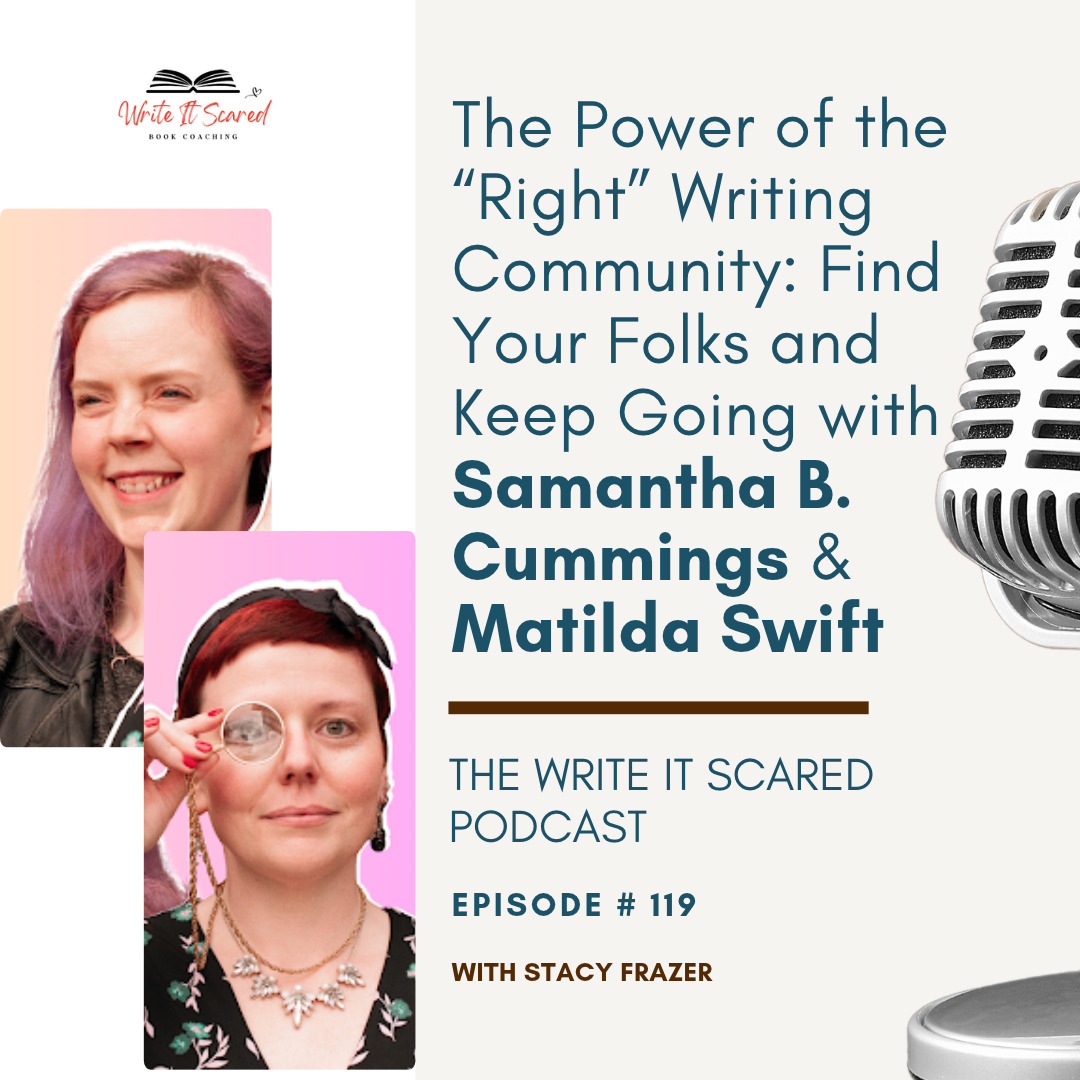
That's why I was excited to sit down with indie authors Samantha B. Cummings and Matilda Swift, hosts of the Pen to Paycheck Authors Podcast, to talk about finding the right writing community.
Between them, Sam and Matilda have published more than two dozen books, and they're still working toward making writing their full-time careers. Their podcast documents that journey as it happens, including the experiments, disappointments, mindset struggles, and occasional wins.
What I loved most about our conversation was that neither pretended to have it all figured out. They're learning, trying things, changing direction when something doesn't work, and doing it together.
Being Around Writers Isn't the Same as Finding Your People
Sam and Matilda came to writing communities from very different directions.
Sam began writing and self-publishing largely in secret. She didn't know other writers, and writing gave her this wonderful private world where she could pursue a dream she'd carried for years. But the further she got into publishing, the lonelier that secret life became.
Matilda, on the other hand, had always sought out creative communities. She attended poetry readings, participated in writing groups, earned a creative writing master's degree, and built relationships with other writers. Yet she still felt stuck.
She was writing books and doing what she thought writers were supposed to do, but she wasn't making the progress she wanted.
It wasn't until she connected with an indie author who helped her understand genre and self-publishing that she began to see a clearer path forward.
I thought that contrast was fascinating. One writer had almost no community. The other had been involved in writing communities for years. And both felt isolated in different ways.
Because being around other writers isn't necessarily the same thing as finding people who can help you move toward your goals.
And there's another layer to this that I think is especially important. When I first started writing, I didn't know other novelists either. My background wasn't in literature. I studied economics and medicine, and somewhere along the way, I developed the false assumption that authors were special people with some kind of magic I didn't have.
Those beliefs can keep us isolated before we've even written a word. When you believe everyone else knows something you don't, it's awfully hard to imagine yourself belonging among them.
Finding the Right Kind of Support
Not all writing communities serve the same purpose, and what you need from one can change as you grow.
Matilda explained that she'd spent years participating in critique groups because that was what she knew. But eventually she realized she needed people who were actively pursuing the publishing outcomes she wanted.
She also pointed out that critique groups can require a lot of vulnerability right out of the gate. You're handing your work to people you may barely know and asking them to tell you what's wrong with it. That's a pretty intimate way to begin a relationship!
Starting with conversations about writing or publishing can give you time to develop trust before exchanging pages. Sometimes a community built around shared goals is more valuable than one built around a shared interest in the writing process.
I see this in my own coaching work. Writers don't all need the same kind of support at the same time. Sometimes the problem is technical. They're struggling with plot, character motivation, or how to get a scene to work. Other times, the real obstacle is the story they're telling themselves about what that struggle means.
They think they're behind. They think everyone else knows what they're doing. They think maybe they're not cut out for this.
And sometimes hearing another writer say, Oh, yeah. I've been there, is more powerful than another craft lesson.
If you've tried writing groups and haven't found your people, that doesn't mean community isn't for you. It might mean you haven't found the right kind yet.
And if I may, and I will because this is my article (HAHA), take a second to check out my Seasonal Small Group Coaching Writing Community! We are small but mighty and just might be your people!
Sometimes All You Need Is One Person
When I asked Sam what she'd recommend to someone looking for a writing community, her answer was beautifully simple: find one person who shares your goals and is willing to take the journey seriously alongside you.
That's essentially how Sam and Matilda found each other.
Sam had posted online about wanting to take her writing career more seriously. Matilda recognized that same desire in herself, and eventually they began meeting to talk about publishing and how they could improve their businesses.
Those conversations became a mastermind group, which eventually became their podcast. Now they've built a larger community of writers who are also trying to turn their creative work into sustainable careers.
All because two people wanted the same thing and decided to work toward it together.
I love that because we tend to think of community as something large and established that we need to find a way into. But community can begin with a single relationship, and sometimes that's enough.
Getting Through the Difficult Middle Together
During our conversation, I brought up Seth Godin's book The Dip, which explores the long, difficult stretch in a worthwhile endeavor when the effort you're putting in doesn't seem to pay off.
And writing certainly qualifies.
You can spend years writing a novel, years learning craft, and even longer trying to find readers or build a publishing career. There are going to be stretches when you wonder whether any of it is worth the effort.
Sam and Matilda know that feeling. Both acknowledged moments when they questioned whether they should continue, but they don't always experience those moments at the same time. One might be having a terrible week while the other feels optimistic about what's coming next. Having someone to talk to helps even things out.
I see a version of this in my small group book coaching cohorts, too. A writer comes in convinced they're the only one who doesn't understand story structure or that they're somehow behind because their draft isn't coming together. Then they hear another writer struggling with something similar, and suddenly the problem isn't evidence that they don't have what it takes.
It's just a problem they can learn how to solve.
That's what the right community can do. It changes the story we're telling ourselves about our ability to write.
It doesn't magically solve our problems, but it does make them feel more manageable. And sometimes that's the difference between giving up and trying one more thing.
You Don't Have to Be Good Enough to Belong
Near the end of our conversation, I asked Sam and Matilda what they'd say to a writer who didn't feel good enough to join a writing community. Because I know there are writers who believe they need to finish a novel, understand story structure, or have something published before they're allowed into the room.
But that's not how learning works.
Matilda pointed out that every person brings something different to a group. Some are great at organizing, some encourage others, and some always know where to find a useful resource. You don't have to be the most experienced writer in the room to belong there, and you don't have to be the most outgoing, either.
One of Sam and Matilda's favorite parts of their Discord community is a channel devoted to asking questions without judgment. Imagine having a place where you can admit you don't know something without worrying that everyone else will think you're an idiot.
That's the kind of environment I work to create at Write It Scared, because I don't believe confidence is something you have to possess before you begin writing. I think it's something you build by doing the work, learning the skills, and discovering that you're capable of more than you thought.
And having people around who believe that, too, makes a hell of a difference.
Parting Shot
We tend to focus so heavily on the outcome of writing: finishing the book, getting published, finding readers, making money. But writing also teaches us patience, persistence, adaptability, and how to tolerate uncertainty. And the right community helps us keep going long enough to learn those lessons.
So if you're feeling isolated in your writing journey, consider what kind of support you actually need. Maybe it's a critique partner, an accountability group, or a community of writers pursuing the same publishing goals. Or maybe it's just one person who understands what you're trying to do and is willing to figure it out alongside you.
You don't have to find an entire village tomorrow. Start with one connection.
Writing a novel is an inside job, and we don't have to do it alone.
Connect with Samantha B. Cummings and Matilda Swift
Samantha B. Cummings writes YA and dark fantasy and can be found on social media as @Samorimo. Matilda Swift writes cozy mysteries under Matilda Swift and cozy fantasy under MW Swift.
Together, they host the Pen to Paycheck Authors Podcast, sharing the highs, lows, and realities of building indie author careers.