Writing a novel sounds like a great idea until you actually have to figure out how to fit the actual writing into your life.
Between work, kids, relationships, and all the other responsibilities demanding our attention, finding the time and mental energy to come to the page can feel damn near impossible.
And even when we do manage to sit down at the keyboard, there's the small matter of figuring out how to write a book in the first place.
Fun times, right?
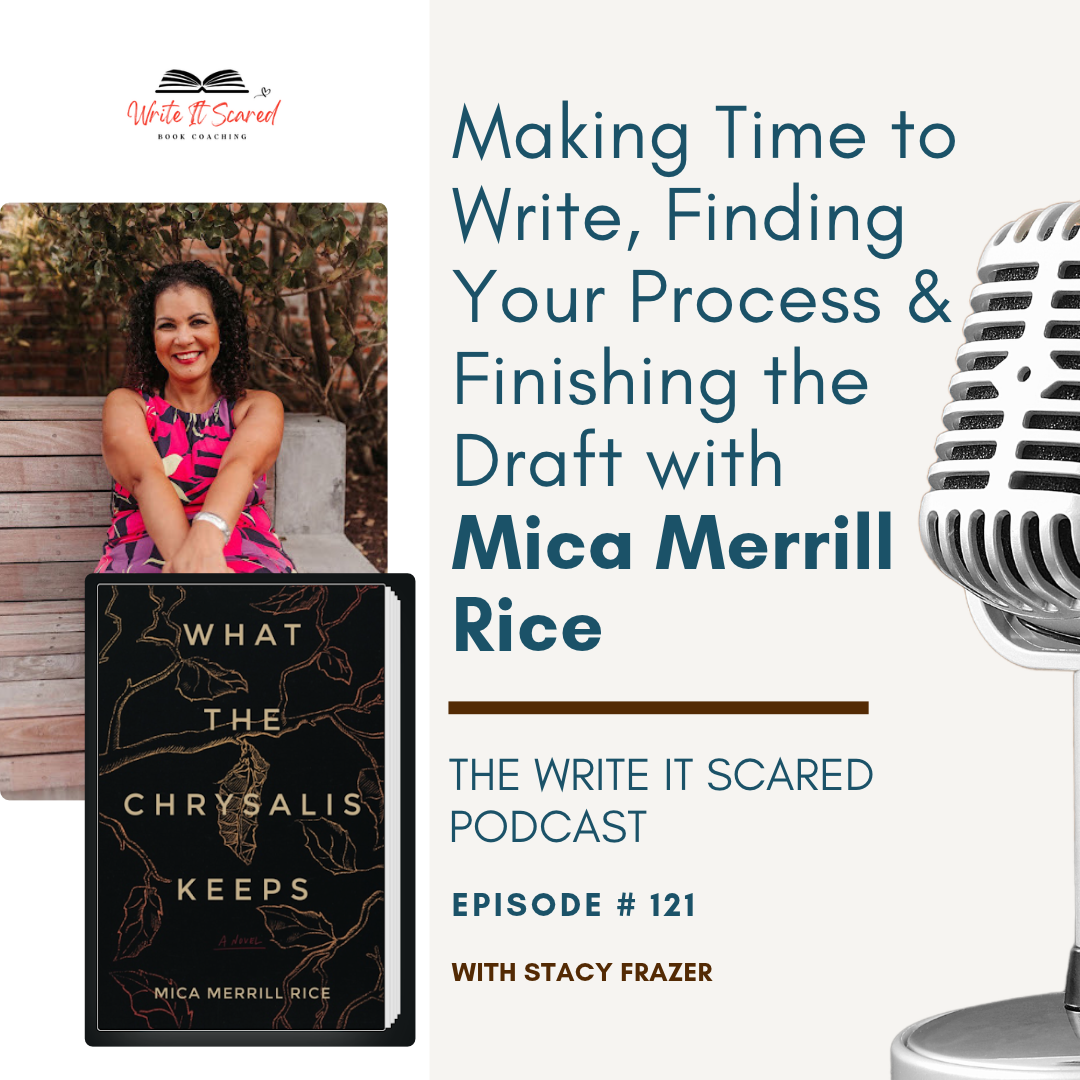
That's why I was excited to sit down with psychological thriller author and fellow podcaster Mica Merrill Rice to talk about her writing journey, the lessons she's learned from publishing her first two novels, and how she's developed a writing process that works for her.
Mica is the author of Deep in the Woods and What the Chrysalis Keeps, and she hosts the Traditionally Self-Published podcast, where she advocates for bringing professional publishing standards to indie publishing.
Our conversation covered everything from writing psychologically complex characters to navigating self-doubt, finding time to write, and why finishing that messy first draft is one of the most important things you can do for yourself as a writer.
And one thing became abundantly clear: There isn't one right way to write a novel, but you do have to find a way that allows you to keep showing up.
Sometimes Writing Begins as a Way to Make Sense of Life
Mica began writing in a journal as a tween to help her make sense of her turbulent emotions as she navigated childhood trauma. Eventually, that turned into poetry. But back then she never considered writing a novel.
Then adulthood happened.
She got busy living, raising a family, and managing the responsibilities that come with both. Writing took a back seat for years, although the idea of writing a novel never completely disappeared.
In January 2020, she finally decided to give it a shot.
But between the pandemic, parenting, and working full-time, the process was anything but straightforward. She started and stopped repeatedly, sometimes going months without touching the manuscript.
Still, she eventually finished and published her debut psychological thriller, Deep in the Woods, in 2024.
And what I find particularly interesting about Mica's journey is how her personal experiences continue to inform her fiction.
Her second book, What the Chrysalis Keeps, follows Red, a woman on the run because of a murder she committed years ago. She finds herself pulled into a secret sisterhood that promises safety but harbors deadly secrets.
It's a dark psychological thriller exploring guilt, power, trauma, and the circumstances that shape human behavior.
Mica explained that writing this book required her to dig deeper into her characters' psychological histories and allow more of her own emotional experiences onto the page.
Not because the events in her fiction necessarily happened to her, but because she understands the emotions behind them.
We talked about how writing emotionally authentic fiction sometimes requires us to draw on our own difficult experiences, even when we're writing characters who make terrible choices.
And that can be uncomfortable.
But it's also one of the extraordinary things about storytelling. We get to take what we know about being a messy human, including the ugly and painful parts, and use it to create something meaningful. For Mica, she gets to explore what happens when women take pain and turn it into power.
Finding a Writing Process That Actually Works
When Mica wrote her first novel, she approached it without much of a plan.
She was pantsing her way through the manuscript, writing whenever she could find the time, and hoping the pieces would eventually come together.
And for her, that approach created some serious challenges.
Because the book took several years to write, details changed along the way. Timelines became inconsistent, characters' names shifted, and the story she started writing in 2020 wasn't quite the same story she'd reached by 2024.
Then she lost the original computer file.
Damn. That hurts. Reminder for both of us: back up our work in multiple places.
Fortunately, she had a printed copy, and losing the digital manuscript forced her to rewrite the book from those pages.
As frustrating as that sounds, she considers it one of the best things that happened to her writing.
She was able to identify inconsistencies, strengthen the story, and make intentional decisions about what belonged in the novel.
And once she'd published that first book, she started asking herself how she could make the process better.
For What the Chrysalis Keeps, she took a different approach.
She began studying story structure and character development, using craft books like Save the Cat! Writes a Novel by Jessica Brody and Story Genius by Lisa Cron to help her plan.
She also sought advice from other authors and editors, read more widely, and became more deliberate about developing her craft.
Now, I want to make something clear here: There's nothing inherently wrong with discovery writing.
Plenty of writers do beautiful work without outlining beforehand.
But that doesn't mean it's the right approach for everyone.
And I can relate to Mica's experience because when I first started writing, I wanted nothing to do with structure.
I'd spent years in a very rigid, linear professional environment, and writing felt like an opportunity to be creative without rules.
Story structure? No, thank you. I just got here!
But eventually I learned that structure isn't the enemy of creativity.
In fact, understanding how stories work can make the creative process easier because you have a framework for making decisions.
Think of it as scaffolding.
You still get to decide what you're building, but you have something to support the work as it takes shape.
The trick is discovering how much structure you need to make progress.
Making Time to Write When Life Is Already Full
Of course, understanding story and story structure doesn't solve the problem of finding time to write.
Mica works full-time and has a family, and for years she struggled to establish a consistent writing routine.
She tried squeezing writing into whatever time she had available, but the approach wasn't working.
During the pandemic, things got really tough. Her young children were at home doing remote learning, and sometimes she just didn't have the time or emotional capacity to write.
At one point, she stepped away from her manuscript for approximately nine months.
Eventually, she returned to it and began experimenting with more intentional habits, including setting timers and gradually increasing her writing sessions.
But the biggest change came when she got realistic about her schedule.
She realized that if she wanted to write consistently, she needed to protect time when nobody else needed her.
For Mica, that meant getting up at five in the morning.
Now she writes before the rest of her household wakes up, sometimes for an hour and a half, sometimes for whatever time she can manage.
And that routine has made a significant difference.
I think there's an important distinction here between wanting to write and creating the conditions that make writing possible.
We can want something desperately, but if we don't make room for it in our lives, it's awfully difficult to follow through.
That doesn't mean everybody needs to get up at five in the morning. It means taking an honest look at your circumstances and figuring out what is realistically available to you.
Maybe that's twenty minutes before work, a dedicated afternoon on the weekend, or three writing sessions each week. Maybe less. Many of my clients have small kids at home, and they write in snippets when they can because sometimes, life genuinely doesn't allow for much writing at all. And we need to honor that instead of feeling like crap about it.
Mica's experience is a good reminder that progress doesn't always happen on the timeline we'd prefer. Sometimes we need to step away, adjust our expectations, then find our way back.
The goal isn't to create a perfect writing routine.
It's to create one you can actually sustain.
Self-Doubt Doesn't Disappear When You Publish a Book
One of the questions I love asking guests is how their relationship with self-doubt has changed as they've gained experience.
Because I think beginning writers sometimes assume that once they've finished a novel or published a book, they'll finally feel like they know what they're doing.
Oh, how I wish that was how it works. I mean, it does on some level. The belief that you can stick with something until the end is solid, but the how-to-get-there part can still be wishy-washy.
Mica doesn't believe self-doubt ever completely disappears, and it certainly hasn't for her.
What has changed is how she responds to it.
She reminds herself that writing is art, and art is subjective.
Not every reader is going to love every book. Even beloved novels have readers who dislike them.
And while knowing that doesn't eliminate her uncertainty, it helps her put criticism and fear into perspective so she can continue working.
We don't need to eliminate self-doubt to become more capable writers. We need to learn how to keep writing while self-doubt is present.
And that ability develops through experience.
Every time we work through a difficult scene, solve a plot problem, revise something that isn't working, or return to the manuscript after stepping away, we're gathering evidence that we can do hard things.
Not perfectly. Not without discomfort.
But we can do them.
Finish the Damn First Draft
Near the end of our conversation, I asked Mica what she wished for writers who were still working on their first novels.
Her answer was simple.
Finish it.
Find a routine that works for you. Experiment with different approaches. Learn what you need to learn.
But finish the book. Because it's easy to get distracted by a shiny new idea when the current manuscript becomes difficult. And it's equally easy to convince ourselves that the draft isn't good enough, that we need to learn more craft before continuing, or that perhaps we should start over.
But here's something I have to remind myself of constantly, even after writing multiple manuscripts:
The first draft doesn't have to be good. It just has to exist.
During our conversation, I shared something a writing friend had recently reminded me of: First drafts are scaffolding.They're the rough structure we build so we have something to work with. And for most of us, the real magic happens through revision.
I recently shared the opening pages of my own psychological suspense novel with my group coaching writers, comparing the original rough draft to the version I'd sent to beta readers.
Same scene. Very different reading experience.
And there were countless rounds of revision between the two. That’s how books are made—in layers, through experimentation, feedback, and iteration.
Yet even knowing this, I still catch myself expecting too much from my first drafts, like the one I’m working on right now.
I want the prose to work. I want the characters to make sense. I want the plot to hold together. And sometimes (often) I forget that figuring those things out is part of the process.
Mica put it beautifully when she described first drafts as a beautiful mess worth celebrating simply because you've completed something.
You can revise a messy draft.
You can strengthen weak scenes, untangle plot problems, deepen characterization, and fix inconsistencies.
But you need something on the page to work with first.
And yes, you might have to rewrite parts of it, maybe a lot of it. That's not evidence that you've done something wrong.
That's simply what it means to write a novel.
Parting Shot
What I appreciated most about my conversation with Mica was how willing she was to acknowledge that her writing process has changed.
She didn't begin with a perfect routine, a detailed outline, or a clear understanding of story structure.She learned through doing. She wrote a book, discovered what wasn't working, sought advice, studied craft, experimented with new habits, and adjusted her process.
And she's still learning.
That's what developing as a writer looks like. Not discovering some magical method that makes writing easy, but becoming more aware of what helps you do the work and what gets in your way.
So if you're struggling to make time for your novel, feeling overwhelmed by craft, or wondering whether you'll ever finish that first draft, consider what you might need to change.
Maybe you need more structure. Maybe you need a smaller writing goal. Maybe you need to protect a little time for yourself or give yourself permission to write something messy.
Whatever it is, remember that your process is allowed to evolve.
You don't have to know exactly how to write a novel before you begin.
You learn how to write one by doing it.
And then you keep learning.
Writing a novel is an inside job, and we don't have to do it alone.
Connect with Mica Merrill Rice
Mica Merrill Rice is a psychological thriller author whose novels include Deep in the Woods and What the Chrysalis Keeps. She also hosts the Traditionally Self-Published podcast, where she explores the craft and business of independent publishing.
Find her books on her website, Amazon, at libraries, and at independent bookstores.