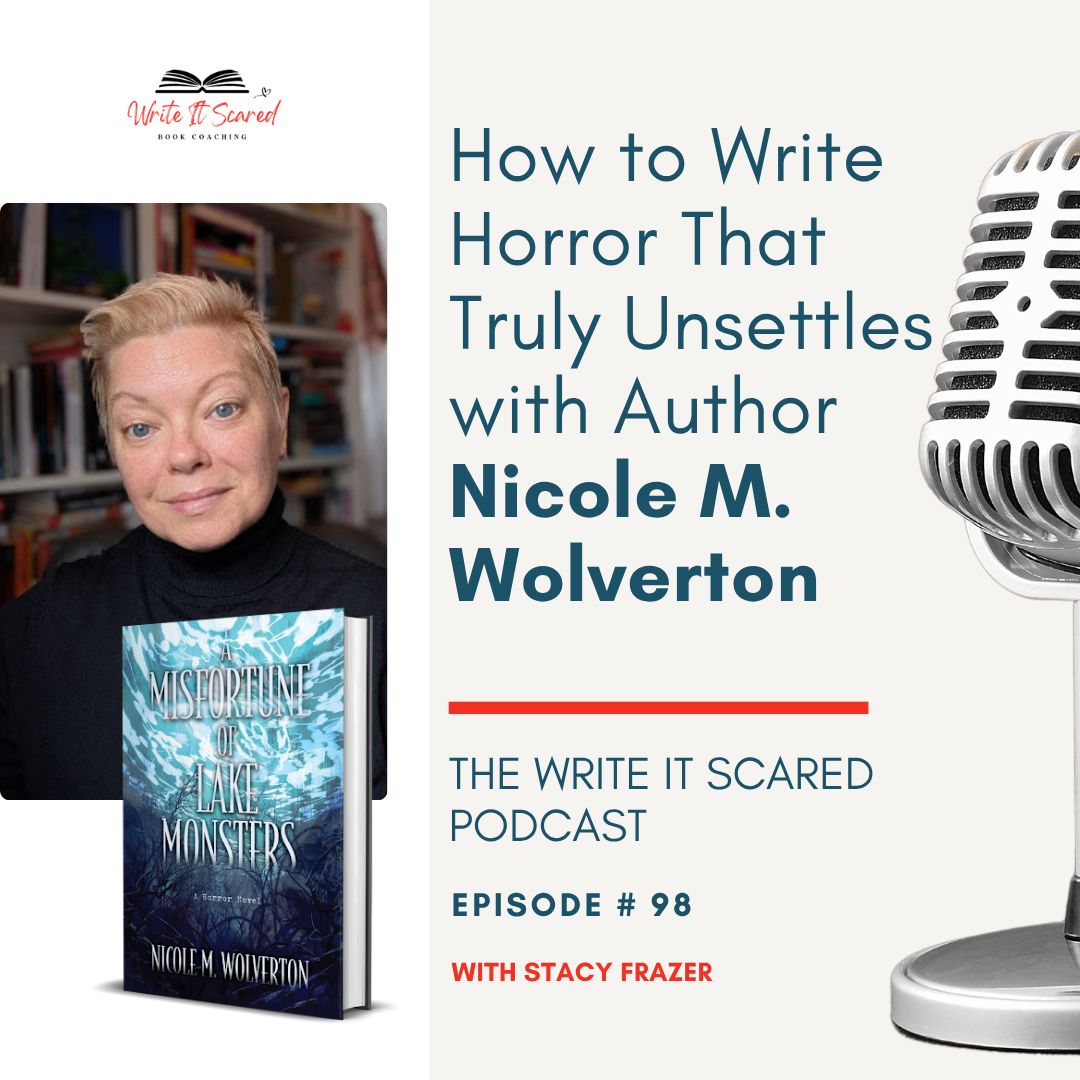
How to Write Horror That Truly Unsettles with Author Nicole M. Wolverton
If the world feels overwhelming right now and you find yourself curling up with a scary movie or reading a page-turning horror novel…you’re not weird. You’re rehearsing in a controlled environment, and that's a very human response.
Horror author, educator, and recent Write It Scared podcast guest Nicole M. Wolverton says we don’t seek out scary stories because we want to suffer. We seek them out because they let us rehearse survival.
That insight is huge for horror writers because what makes horror powerful on the page is the same thing that makes any story resonate: it forces us to confront what scares us—and imagine who we could become on the other side.
“A good horror story makes you confront something you personally find scary—but also makes you feel like you might have the power to kill your own monsters.”
Horror Isn’t About Fear — It’s About Loss of Control
Nicole’s work, which spans YA and Adult horror, thrillers, and the delightfully disturbing sub-genre of gastro horror, grows from a deceptively simple idea: Horror gives us a safe container for dangerous feelings.
During crises—pandemics, political instability, personal upheaval—media consumption of horror spikes. Not because people want more fear, but because they want predictable fear. They’re looking for some means of control.
In stories, the terror has edges. A shape. A narrative arc. Sometimes, even a solution.
Your brain gets to practice:
What would I do?
How could I survive this?
Who would I become?
Nicole shared that research suggests people who regularly consume horror media may show greater emotional resilience during real-world crises.
For writers, this reframes horror from a spectacle into working psychology.
The monster isn’t the point. It’s the forced confrontation that matters.
The Real Engine of Horror is Discomfort
One of my favorite takeaways from our conversation was this: Horror doesn’t have to be terrifying to work. It just has to be deeply unsettling.
Silence. Isolation. Smells. Spaces. Social tension. Loss of control.
Anything that makes the reader squirm can carry horror energy.
Nicole grew up in rural Pennsylvania and writes eerie, isolated settings because those spaces feel unsafe to her. That personal emotional truth becomes the fuel for her fiction.
And that leads to the most useful craft advice in the entire conversation:
Start with what scares you.
Not what you think will scare readers. Not what’s trendy. Not what’s marketable. Because your fear is specific, and that specificity creates authenticity and impact.
What’s Gastro Horror?
Nicole also studies and writes gastro horror—a sub-genre that explores fear through food, consumption, disgust, and power. Her newest work, Meat Sweats, a novel about a young female vegetarian who turns cannibal, will be out in the summer of 2026.
Gatro horror asks the question: What if the thing that sustains you becomes the thing that destroys you?
Turn something necessary like food into something dangerous, and you’ve got instant unease.
The Hardest Part of Writing Isn’t the Writing
Like many published authors, Nicole says the real struggle often isn’t producing the work. It’s everything surrounding it:
Rejections
Publishing uncertainty
Lack of control
Industry chaos
Comparison
Waiting
At the time of our conversation, her publisher was in flux after a series of corporate changes, leaving authors in limbo about the fate of their books.
Which highlights a brutal truth about publishing: Most of what determines outcomes is outside your control.
The only reliable power you have is to keep showing up for the work itself.
The Advice Every Writer Needs to Hear
Nicole spent years in nonprofit fundraising, and one lesson carries directly into writing life:
If you don’t ask, you don’t get.
So…submit the story. Pitch the agent or panel. Propose the project.
Don’t be the first person to tell yourself no.
Podcast: Guest Bio:
Nicole M. Wolverton, an unapologetic fear enthusiast, writes horror and thrillers for adults and young adults. She is the author of A Misfortune of Lake Monsters (CamCat Books, 2025), The Trajectory of Dreams (Bitingduck Press, 2013), and the upcoming Meat Sweats (Horrorsmith Publishing, 2026). She also served as Editor of the menopause-themed horror anthology Bodies Full of Burning (Sliced Up Press, 2021). Her short fiction, creative nonfiction, and essays also appear in about 50 anthologies, magazines, and podcasts. Nicole holds a master's degree in horror and storytelling from the University of Pennsylvania; her academic interests center on building resilience through horror media and gastrohorror.
To connect with Nicole and read her books, please visit her website.