What if trusting your writing process means letting go of the need to know how everything will turn out?
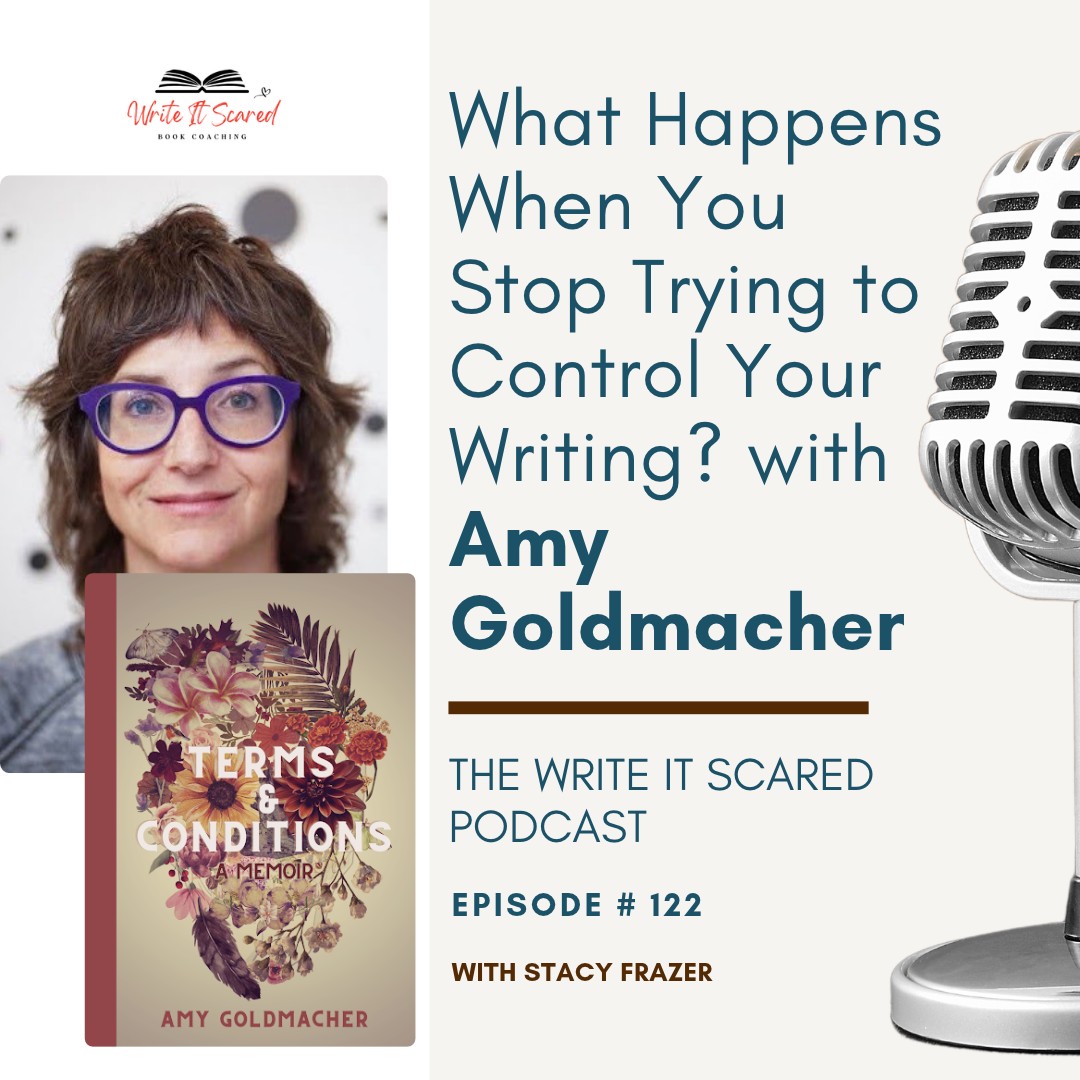
I recently had the pleasure of interviewing Amy Goldmacher about her memoir, Terms & Conditions, which resonated with me on a very personal level.
Now, I don't typically interview memoirists on the Write It Scared podcast. After all, this show is dedicated to fiction writers and the brave, vulnerable work of writing novels. But Amy's memoir explores something that I believe is incredibly relevant to our writing lives: the beliefs and behavioral patterns we develop early in life, how those patterns shape our relationship with ourselves, and what happens when they follow us into our creative work.
We talked about the desire for control over outcomes, self-worth, the uncertainty of writing, and what happens when we create something without knowing how it'll turn out.
And, as a fun little bonus, this is also the conversation that sparked my F@ck Around and Find Out November writing challenge.
The Terms and Conditions We Carry Into Our Writing Lives
Amy's memoir, Terms & Conditions, explores the idea that “the conditions we grow up with don't have to determine the rest of our lives.”
The book is structured as an experimental glossary of moments, memories, and experiences rather than a traditional chronological narrative. Through those entries, Amy examines her relationship with anxiety, her father, grief, family dynamics, and the patterns she developed to navigate her world.
One of the things that resonated with me most was the relationship between our early experiences and the ways we learn to protect ourselves.
Sometimes those strategies are incredibly useful. In Amy’s world (and mine), that meant learning to observe our environments, anticipate problems, work hard, strive for perfection, and do whatever we can to create a sense of safety and predictability.
But what happens when those same strategies become obstacles? What happens when our need to get things right, avoid mistakes, or control outcomes follows us into our writing?
For me, this is personal.
I spent years not writing because of the beliefs I'd absorbed about myself and what I was capable of doing and what I SHOULD be doing, what I thought I was allowed to do. It took a lot of unlearning before I could begin putting my words on the page.
And even now, after years of writing and working with other writers, I still recognize those old unhelpful patterns showing up in my creative process.
Maybe you do, too.
Perfectionism, Control, and the Uncertainty of Writing a Novel
Here's something I find particularly ironic about being a writer.
We can work incredibly hard, study craft, revise our manuscripts, seek feedback, and do everything we believe we're supposed to do. And we still can't control what happens to our stories.
We can't control whether readers will love our books or hate them, whether an agent will offer representation, or whether the book will find its audience. Sometimes we can't even control how a scene unfolds once we start writing it.
And if you're like me, someone who has spent much of your life trying to create safety through preparation, performance, or perfectionism, that uncertainty can be painfully uncomfortable.
During our conversation, Amy and I talked about the difference between focusing on our efforts and trying to control outcomes. Our effort is something we can influence. The outcome? Not so much.
That's not always an easy distinction to live by, especially when we're deeply invested in the stories we're telling.
Sometimes, subconsciously, I get so focused on what I want a finished book to become that I struggle to stay in the moment with the story. To be where I need to be: exploring, drafting, reworking a scene. I lose sight of what I actually need to do to reach my goal of finishing the book and instead let fears and doubts drown out my joy of discovery and creation.
Tolerating uncertainty isn’t easy. But it’s a skill you can learn and hone.
Letting the Story Become What It Wants to Be
One of my favorite parts of Amy's writing journey is how Terms & Conditions found its form.
When she began writing the memoir, she imagined a traditional, chronological collection of personal essays. She wrote about twenty pages and shared them with some trusted writer friends.
Their feedback?
It was boring to read. Ouch.
But Amy considered their feedback. She allowed for some uncertainty. She explored.
Rather than forcing the manuscript to fit her original vision, she took it apart.
She broke the chapters into smaller pieces, put them into a spreadsheet, examined what each piece was really about, and eventually arranged the material alphabetically.
And suddenly, something clicked.
The book began to take shape as a glossary, written in second person, rather than the chronological first-person narrative she'd originally planned.
I love this example because it shows something many writers struggle with.
TRUST THE STORY AND THE PROCESS.
Sometimes (OFTEN) the process of writing reveals something we couldn't have known when we started.
That doesn't mean planning is bad or that structure isn't useful. It means our plans can and will evolve as our understanding deepens.
And sometimes the most productive thing we can do is stop trying to force the work into a particular shape and get curious about what might be possible instead.
Which brings me to something else Amy and I spent a lot of time talking about: self-trust.
Trusting Yourself When You Don't Have All the Answers
Lord knows that writing provides endless opportunities to doubt ourselves.
We wonder whether our ideas are good enough, whether we're making the right story decisions, whether we're wasting our time, and whether the manuscript will ever become what we hope.
And we (I) want answers preferably before we've done the work!
But the reality is that we really can't know if something will work until we've tried it.
Amy talked about a reminder she keeps on a sticky note near her writing space:
"Create before you know how it will turn out."
I love that because it means you’re choosing to believe you can figure things out as you go that it’s okay to explore. That creating for the sake of writing has merit.
You can write something messy and revise it. You can make a decision and change your mind. You can discover that your original plan isn't working and try another approach.
And you can keep going even when you don't know exactly where you're headed.
That's a very different relationship with the creative process than one built around getting everything right the first time.
Of course, knowing that intellectually and actually practicing it are two very different things.
I can be working on a chapter and suddenly find myself thinking that it's boring, the writing is terrible, the story isn't going anywhere, and I have absolutely no idea what I'm doing.
Sound familiar? Just yesterday, a writer shared that what they’d been revising a few days earlier had felt boring and poorly written. They came back to it a day or two later and were like, “Huh, this isn’t bad at all.”
But those unhelpful thoughts can feel incredibly convincing in the moment.
But here's something I learned years ago that I still come back to:
Feelings aren't facts.
Our feelings give us information, but that doesn't automatically mean the story we tell ourselves about them is true.
Sometimes the writing really does need work. Sometimes we're tired, overwhelmed, or trying to evaluate a messy first draft as though it should already be a polished manuscript. And sometimes we're simply uncomfortable because we're doing something difficult and uncertain.
Amy described a practice of noticing an emotional reaction, acknowledging it, checking whether it reflects the present situation, and then letting it pass.
I think there's tremendous value in bringing that same awareness to our writing.
Instead of immediately accepting that this story is terrible as a fact, we can get curious about what's actually happening. Are we struggling with a genuine story problem? Do we even have enough information to evaluate the work yet?
Or are we expecting a finished result from an unfinished process?
That little bit of distance can help us respond intentionally instead of letting fear make our decisions for us.
And sometimes the best response is to give ourselves permission to play.
Building a Different Relationship With Your Writing
One of the things I appreciate most about Amy's memoir is that it doesn't suggest we can simply decide to stop being perfectionists, stop worrying, or stop wanting control.
Those patterns can be deeply ingrained.
But we can become more aware of them. We can recognize when an old belief is influencing how we approach our creative work, and we can start making different choices.
We can practice tolerating uncertainty and appreciating our efforts rather than measuring every writing session against an imagined outcome. We can let our stories evolve and build the self-trust to believe that even when the process gets messy, we'll find a way forward.
That doesn't mean every writing session will feel wonderful, or that we'll never doubt ourselves again.
But it does mean we have some agency over the relationship we build with our writing.
And I think that's a pretty powerful thing.
Because the goal isn't just to finish a novel.
It's also to become a writer who trusts themselves enough to keep creating.
And that is exactly the entire philosophy behind Write It Scared Book Coaching and my Group Book Coaching Programs for fiction writers.
What’s that saying… we become the teachers of the things we need to learn the most.
About Amy Goldmacher
Amy Goldmacher is the award-winning author of Terms & Conditions, an experimental memoir told through a glossary of moments, memories, and artifacts in fewer than 15,000 words.
Her writing has appeared in The New York Times, Monkeybicycle, Essay Daily, and other publications. She is also the co-author of a traditionally published anthropology workbook.
Learn more about Amy and her work at amygoldmacher.com.
Get Book Coaching Support for Your Novel and Learn to Tolerate Uncertainty and Trust Yourself and the Process.
If you're feeling stuck in story development, lost in drafting, or frustrated in revision, you don't have to figure everything out on your own.
My Write It Scared Seasonal Group Coaching Community offers personalized story, craft, and mindset support, plus accountability and a small community of writers working toward their own writing goals.
Our Spring 2027 season kicks off January 5, with just six writers per group.
The discounted early enrollment rate (a savings of $250!) is available through December 11, 2026.