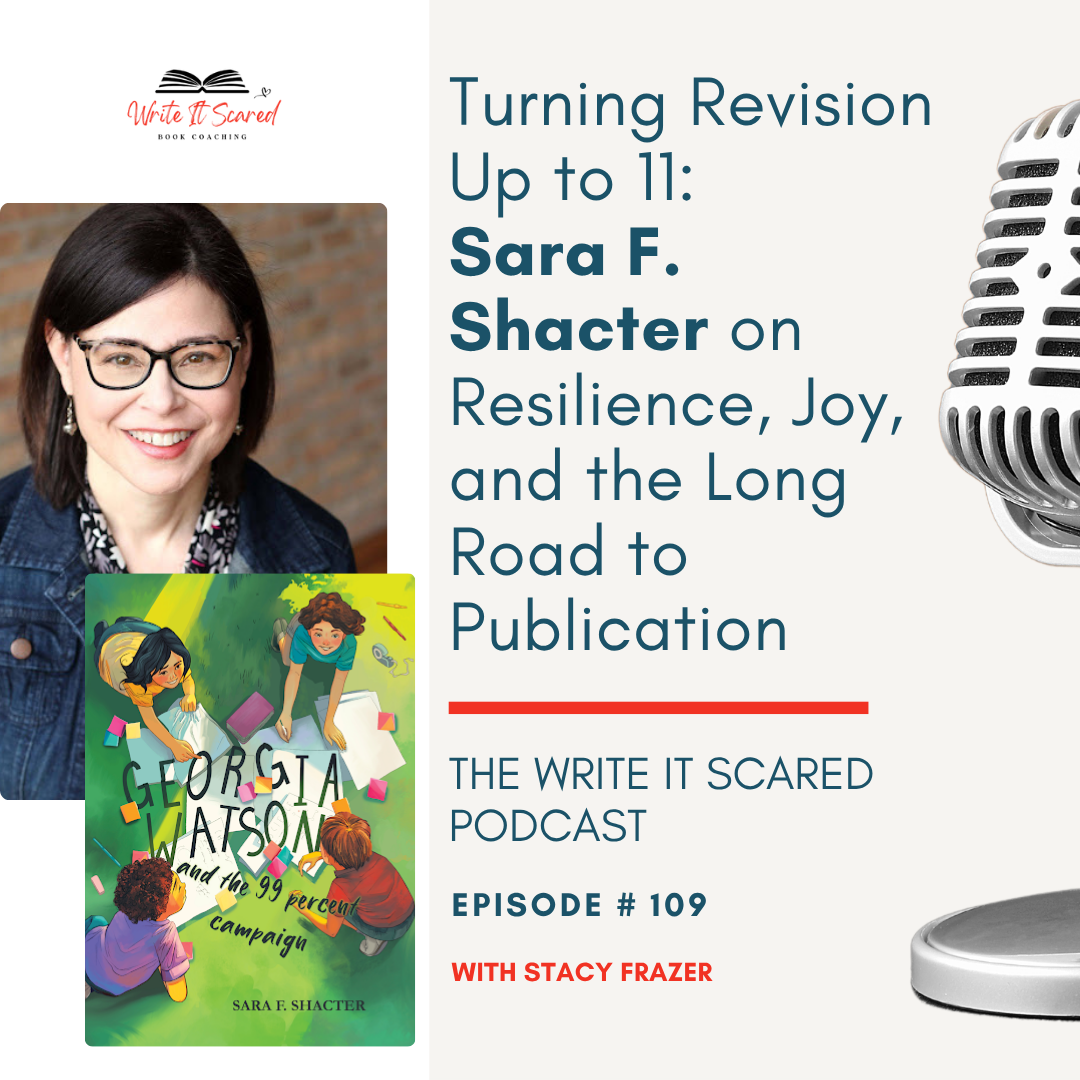
Turning Revision Up to 11: Sara F. Shacter on Resilience, Joy, and the Long Road to Publication
One of the things I love most about talking to writers is hearing the real story behind a published book.
You know, the version filled with false starts, rewrites, doubt spirals, unexpected breakthroughs, pouting periods, and moments where the author wondered if the story was ever going to come together at all.
That’s exactly the kind of conversation I had this week with middle grade author Sara Shacter about her debut novel, Georgia Watson and the 99% Campaign.
So if you’re currently in revision hell with your novel, this episode will help.
The Book Changed Completely Over Time
Georgia Watson and the 99% Campaign took 15 years to become the version it is today.
The original story is almost unrecognizable to what the book is now. It featured completely different characters, a different family dynamic, and a very different emotional theme. Even Georgia herself wasn’t originally named Georgia.
Over the years, the manuscript evolved through multiple major revisions as Sara slowly uncovered what the book was actually about.
Many writers assume that published books arrive in the author's mind fully formed, and, to be fair, sometimes they do. But more often, the real story only reveals itself through multiple rounds of revision.
And in Sara’s case, the key to unlocking the story late in the revision game was the “99%” concept: the scientific fact that genetically, human beings are more than 99% the same. That idea became both the emotional and thematic core of the novel.
The Feedback That Changed Everything
One of the most interesting parts of Sara’s publishing journey came after she signed with an agent and the manuscript went out on submission.
Multiple editors passed on the book for the exact same reasons:
the emotional stakes weren’t strong enough
and the story lacked a clear marketing hook.
That kind of consistent feedback is hard to ignore.
At first, Sara struggled with the idea of what a “hook” even meant for her story. She knew the book involved science, genetics, friendship, and identity, but nothing felt distinct enough to immediately separate it from other middle grade novels.
Then editor Deborah Halverson asked her a deceptively simple question:
“When someone thinks about your book, what’s the fill-in-the-blank description?”
That question changed things.
Because Sara realized her answer at the time was essentially: “It’s about a girl who gets into a fight with her friend and then they make up.”
And while friendship stories are wonderful, there wasn’t yet a defining concept that made the novel feel unique.
After years of revising only to be rejected while on submission, it took another five months of thinking, researching, and wrestling with the manuscript before Sara finally discovered the “99%” fact—and suddenly the entire story clicked into place.
But that meant the book would have to go through another major rewrite.
Taking the Book Back Down to the Studs
At one point during our conversation, Sara described deleting nearly half the manuscript and rebuilding the story from the ground up.
And somehow… She genuinely loves revision. Me? I’d want to throw up.
Most writers I know—including myself—experience revision as equal parts creative discovery and existential crisis.
But Sara approaches revision differently.
She compared it to “turning the story up to 11,” which I absolutely loved. Instead of seeing revision as the boring cleanup phase, she sees it as the moment where you amplify everything important:
the emotional tension
the character dynamics
the stakes
the themes
the heart of the story itself
And because of that mindset, revision became less about “finding and fixing mistakes” and more about experimenting with the story and her revision methods.
She used spreadsheets. Index cards.Scene tracking systems.Color coding.Writing exercises from craft books.
Whatever helped her understand the story's shape more clearly.
That flexibility is such an important takeaway because revision is rarely linear.
My biggest takeaway is that sometimes the best thing you can do is stop trying to protect the existing draft and allow yourself to rebuild it.
Doubt Never Fully Disappears
Of course, fifteen years is a very long time to stay emotionally connected to a project.
And Sara was incredibly honest about the moments where doubt nearly stopped her.
There were stretches where she couldn’t even read middle grade novels because she felt too bitter and discouraged watching other authors succeed while her own book remained unpublished.
There were moments where she worried she would never figure out the missing piece of the story.
And perhaps most painful of all, there was the moment where she lost her literary agent after years of working together and suddenly found herself back in the uncertainty of the query waters all over again.
I think what struck me most, though, was how often she allowed herself to pause instead of forcing solutions before she was ready.
When she couldn’t figure out the hook, she stopped pushing. When she felt emotionally overwhelmed, she stepped back. When the story wasn’t working, she gave herself permission to rethink it entirely.
To me, that demonstrates creative flexibility mixed with maturity.
Learning to Focus on the Work Instead of the Outcome
One of the biggest themes that emerged throughout our conversation was the importance of shifting focus away from outcomes and back toward the work itself.
Sara talked about how easy it is to become consumed by comparison in publishing:
Who got starred reviews? Who landed another contract? Who made the bestseller lists? Who seemed to be advancing faster.
But over time, she’s learned to ground herself in the quieter, more meaningful parts of the experience:
connecting with young readers
visiting schools
hearing how stories impact kids
staying connected to the joy of storytelling itself
That’s important wisdom for writers at every stage of the journey.
Because publishing goals are moving targets.
There will always be another milestone. Another comparison point. Another thing you could chase.
But joy? Connection? Creative fulfillment?
Those are the things that actually sustain us long term.
Final Thoughts
Sara’s writing journey completely dismantles the myth that successful books emerge quickly or cleanly.
This novel took fifteen years. It survived multiple massive rewrites. It survived rejection and losing an agent. It survived periods of doubt, uncertainty, and discouragement.
And so did Sara—not by being perfect or fearless. But by consistently returning to the story that meant a lot to her.
Sometimes the stories worth telling just take a long time.
Where to Connect with Sara Shacter
You can connect with Sara Shacter and learn more about her work, Please go to her website.
Her debut middle grade novel, Georgia Watson and the 99% Campaign, is available now.