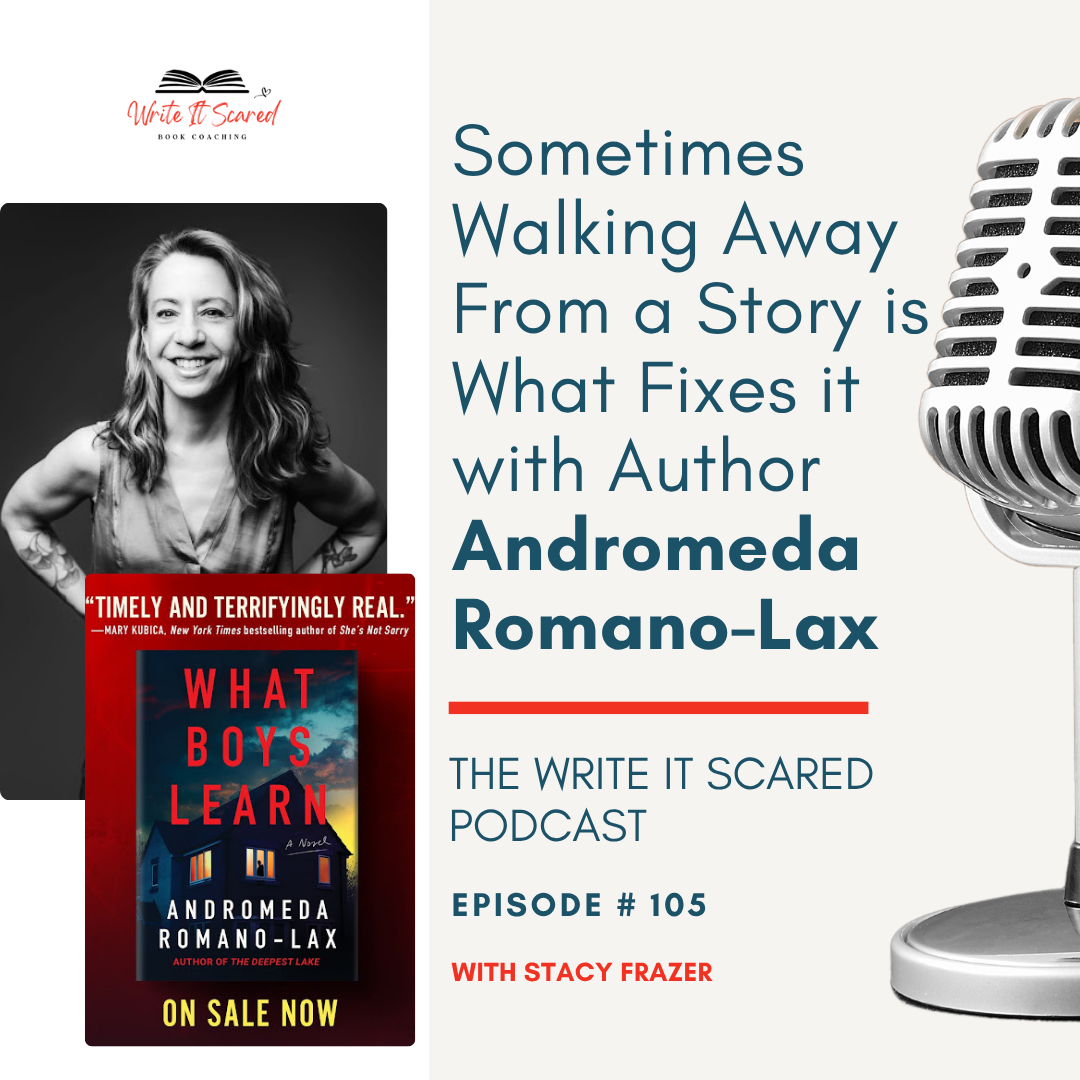
Sometimes Walking Away From A Story Is What Fixes It With Author Andromeda Romano-Lax
This blog post captures the highlights of my recent podcast conversation with author Andromeda Romano-Lax, and it’s all about giving ourselves permission. The permission to walk away if needed. The permission to develop stories differently every time. To think, to breathe, to learn as we go.
Now I don’t know about you, but when I think of walking away from a story I’ve bled over for a while, it feels a bit like a failure.
But what if setting your draft aside isn't a failure?
What if it’s actually part of the process?
That idea came up again and again in this week’s Write It Scared podcast conversation with author and developmental editor Andromeda Romano-Lax.
And talking with her felt like unlocking another level in my permission slip—and I hope it will do the same for you!
We live in a culture obsessed with visible productivity. Word counts. Draft deadlines. Daily consistency. We’re taught to equate movement with progress, so the moment a project slows down or stops cooperating, panic ensues. I’ve seen it with myself and many of the writers I work with.
When we choose to pause (or life chooses it for us) we assume we’ve lost momentum. Or worse, that we’ve lost the story entirely.
But that’s not the truth and some stories don’t reveal themselves all at once.
It made me think of a conversation I had with a client about Kristin Hannah’s The Women. The seeds for that story were planted in 1997, but the book wasn’t published until 2024.
A story takes what it takes. Life takes what it takes. And sometimes that pause is a blessing. Sometimes we have to write other things to develop the skill level necessary to write a particular story.
That means practice. And practice means writing.
When Walking Away Is Part of the Work
Andromeda talked about how she used to see setting a project aside as failure. If a draft stalled or wasn’t working, it meant she had wasted time. But over the years—and seven published books later—she’s come to see that differently. Now she lets projects “compost.”
She trusts that stepping away can sometimes be the very thing that allows the deeper version of the story to emerge.
That really resonated with me because I think so many writers experience this exact thing, especially when working on complex stories like mysteries or psychological thrillers. You hit the middle of the draft, and suddenly the excitement fades. The shiny spark that got you started burns out, and all you can see are problems.
That happened to Andromeda while drafting her most recent thriller, What Boys Learn.
She got about 65,000 words into an earlier version of the novel before realizing something wasn’t working. The story had lost energy, and she was bored writing it. The ending she thought she was building toward no longer felt compelling. Not knowing what to do at the time, she set the project aside.
Not for a week.
For two years.
And then, sitting on a plane to Utah, the breakthrough came. Suddenly, she understood what the book actually needed. The structure changed. The tension changed. The story deepened.
I loved hearing that because it pushes back against this idea that every breakthrough has to happen at the keyboard.
Some of the biggest creative breakthroughs happen while walking, driving, showering, folding laundry, staring out airplane windows, or lying awake at night thinking about a story that won’t leave you alone.
Those quieter moments matter.
They’re part of the work too.
Thinking Is Writing
Writers often undervalue thinking.
We want tangible proof that we’re making progress. Words on a page feel measurable. Thinking feels indulgent. But stories are built in the subconscious long before they fully arrive on the page.
That’s especially true with psychological suspense.
One of the things Andromeda and I talked about was how deceptively difficult thrillers are to write. From the outside, they can seem formulaic: there’s a mystery, a reveal, escalating tension.
But psychological thrillers live and die on emotional layering and hidden motivations. The writer has to understand not only what readers think is happening, but what’s actually happening underneath the surface.
And that requires a lot of thinking.
A lot of revising.
A lot of circling back.
One insight from the conversation that really stuck with me was Andromeda’s point about understanding the antagonist’s perspective. Writers often focus so heavily on the victim or protagonist that they don’t spend enough time understanding the deeper motivations driving the opposing force.
But suspense is built from a combination of pressure paired with reader questions. It’s the collision between what the protagonist wants and what the antagonist wants that creates the conflict and momentum.
The Emotional Weight of Writing
Beyond the craft discussion, what I appreciated most about this conversation was how openly we talked about the emotional side of writing.
Even seven books into her career, Andromeda still wrestles with self-doubt. She talked about criticism, unlikable character feedback, and how easy it is for those comments to stop feeling like critiques of the work and start feeling like critiques of the self.
Very relatable.
Someone dislikes a character you wrote, and suddenly your brain starts whispering that maybe you’re difficult. Maybe you don’t understand people. Maybe you’re fundamentally getting something wrong.
That spiral can happen so fast.
And then there’s the negativity bias so many creatives struggle with—the tendency to skim over ten kind comments while obsessing over the one critical review. Andromeda talked about how consciously she now tries to redirect her attention toward the positive instead of automatically hunting for threats.
That hit hard because most of us are far quicker to absorb criticism than encouragement. We almost distrust praise. But criticism? We tattoo it onto our nervous systems.
And yet, staying in the creative process requires some ability to pull ourselves back into the present instead of spiraling toward imagined future judgment.
Because when we’re drafting, our job isn’t to manage reviews that don’t exist yet.
Our job is to stay close enough to the story to hear what it needs.
The Stories We Tell Ourselves
Toward the end of the conversation, Andromeda shared something I loved. She said writers limit themselves with myths. Myths about age. About genre. About talent. About what kinds of careers are allowed. And instead of constantly looking for evidence that those fears are true, she believes writers need to actively seek evidence that possibility exists instead.
That feels especially important right now.
Writers spend so much time arguing for their limitations. We convince ourselves it’s too late, too crowded, too hard, too unrealistic.
But the truth is, creative careers are rarely linear.
Neither are creative processes.
Trust the Becoming
Maybe trusting the process doesn’t mean believing that every draft will work perfectly the first time.
Maybe it means believing that even when you’re stuck, stalled, doubting yourself, or stepping away for a while…
You’re still becoming the writer capable of finishing the story.
Sometimes the story just needs more time before it can fully tell you what it wants to be.
To connect with Andromeda, read her many helpful substacks, and purchase her books, please visit her website. She enjoys hearing from readers. You can also find her on Instagram.