Celebrating Episode 100 of the Write It Scared Podcast!
Episode 100.
Holy shitballs! (Love to you, Liubov 😉)
100 conversations with writers, about writing, for writers. 100 conversations about being scared and showing up anyway.
This podcast started out as one of those “someday” ideas that came along with a huge side of “who the hell do you think you are, Stacy?!”
And I’m so glad I didn’t listen to my overprotective, sometimes a-hole, inner critic (much.) It’s been such a privilege to host this show and provide a platform for writers and industry professionals to share their stories, experiences, and expertise.
We, writers, are amazing—kind, thoughtful, generous people—and I want to say thank you to all the guests and to you for listening and being here.
Because without you, none of this would matter.
And to be completely honest, there have been days when I wondered if it did matter. Where downloads seemed to flatline, and it felt like I was talking to a void.
But those were feelings, not facts. (See what I did there?! LOL)
The fact is, the show does matter.
It reaches people, helps them work through fears and doubts, and encourages them to keep writing.
That’s all I ever hoped for.
When I first imagined this podcast, I wanted to create something I felt we all needed to hear—not just in the early stages of writing, but at every stage. Something to combat the common denominator that keeps so many of us stuck: Doubt. And because of the awesome guests who are willing to share and be vulnerable, that’s what we have today!
But it’s not just them…
If you’ve:
ever written when you didn’t feel ready…
ever doubted yourself but kept going anyway…
ever hit play on this podcast hoping for a little courage…
Then you’re a part of this!
Proof, Pudding, and All That
Recently, I heard from a listener who emailed that they’re 60,000 words into a novel; their first in over a decade. Largely because of an early episode on overcoming procrastination.
Another writer emailed to say they had pursued traditional publication for nearly twenty years but had always avoided live pitching events because it terrified them. After listening to literary agent Amy Nielson discuss live pitching in Episode 51, they decided to try it. That decision led to signing with an agent. As of this newsletter, their book is now on submission.
Stories like these are why this podcast exists.
The Core Belief
Write It Scared was built on one simple belief:
We can be scared and still be unstoppable if we choose not to do it alone.
Which brings me to the thing I’m so excited about, because 100 episodes is just the beginning!
Introducing a New Podcast Segment
The Courage Files — And I Want Your Story
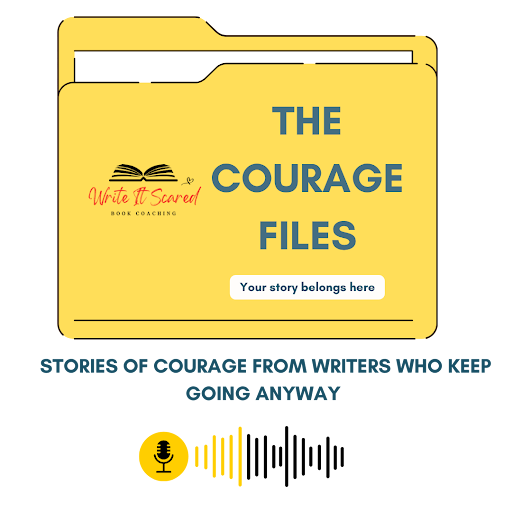
The mission of Write It Scared has always been to give you practical writing tools and mindset support to help you move forward despite doubt.
And one of the most powerful tools we have is each other.
It’s in each other that we find HOPE.
HOPE = Hearing Other People’s Experiences.
When we hear what other writers have faced—and how they kept going—something inside us shifts.
We feel less alone. More capable. More willing to try.
Which is exactly what the Courage Files will capture.
Think of it as a living record of writers doing hard, brave, messy things…when no one is watching.
And I want you to be a part of this.
If something in your writing life has shifted—big or small—because of this podcast or simply because you chose to keep going…I would be honored to hear about it and share it on the podcast (anonymously or not—your choice).
And wins don’t have to be dramatic, like landing an agent or publishing a novel.
Because the courage that counts is so often quiet.
It might look like:
Starting again after a long break
Finishing a chapter, or a scene, an outline, or a synopsis that you struggled with
Submitting your work somewhere for the first time
Letting someone read your words for the first time
Asking for feedback
Setting boundaries to protect your writing time
Untangling a plot problem or unlocking a character motivation
Choosing to keep going when you wanted to quit
Most of us are crap at celebrating our efforts, our wins (myself included)
And that needs to stop. We need to give ourselves credit, not just for the big shit, but for all the tiny steps that move us toward our dreams, because without those, we have nothing. So the moment you think is “too small” to matter is the exact moment you need to celebrate and maybe the exact moment someone else needs to hear about to keep going.
All forms of courage count.
If this podcast has ever helped you keep going, I would love to hear your courage moment.
Submissions are open now.
Let’s work together to spread more HOPE throughout the writing world by sharing wins so other writers who are struggling can see what’s possible and help you practice seeing your gains!
A New Quarterly Drawing
Beginning in Season 4 (September 2026), I’ll randomly select one submission per quarter to receive:
An editorial assessment of up to 10 pages of your manuscript
A 30-minute one-on-one coaching session with me
No purchase necessary.
The only action you need to take is to submit to The Courage Files. And with your permission, I’ll share it on the show—anonymously or with your name—to inspire other writers. Because again, your moment might be the exact thing another writer needs to hear.
HOPE, right?
If you’re not sure your story win ‘counts,’ then it absolutely does.
Become a Patron and Support the Podcast
It feels vulnerable to ask for support. But this podcast is about doing meaningful things even when they’re uncomfortable…so, here I am.
If this podcast has helped you, encouraged you, or kept you company while you work on your writing, and you’d like to help it continue, please consider becoming a patron of the show.
For less than the cost of one fancy coffee per month, you can help support the show financially, which would go toward covering the production costs.
No pressure at all. The show will remain free.
But if you’ve ever wondered how to say “thank you” in a tangible way, this is one option.
Listening, sharing the show, and simply being part of this community already means a great deal. Financial support is just one way to help—not the only one.