What do butlers, Regency settings, and hilarious romantic misunderstandings have in common?
Kate Archer.
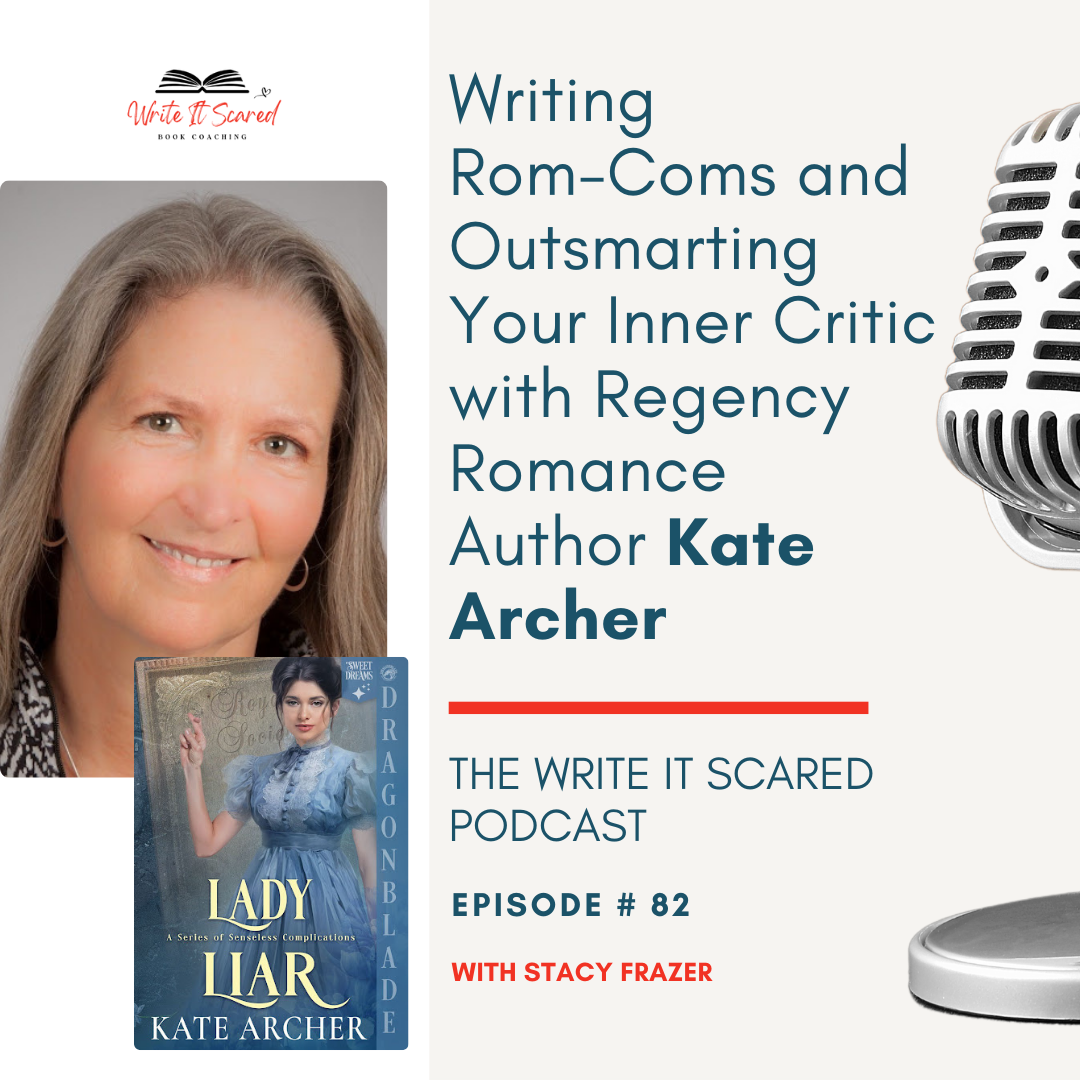
In this week’s episode of The Write It Scared podcast, I sat down with Kate to talk about her journey as a Regency rom-com author, how she blends humor with character truth, and what it really takes to write stories that make readers swoon and laugh simultaneously.
Whether you’re new to romance, curious about writing romantic comedy, or need some mindset help to get you going, there’s so much here to take with you.
Lowering the Bar to Let the Words Flow
When Kate first started writing, she had big dreams…but also big expectations.
For a while, that pressure kept her from finishing anything. But things changed when she stopped trying to write a “bestseller” and instead gave herself permission to write something small and fun.
That shift—removing the pressure to prove something—opened the creative door.
By lowering the stakes, she found her rhythm and rediscovered her joy. It was a powerful reminder that sometimes the thing that unlocks our writing is giving ourselves permission to just play.
To date, Kate has published more books than I can count on both hands!
Humor That Comes From the Inside Out
Kate’s books are full of playful misunderstandings and awkward social dynamics, but what makes her humor land is that it grows naturally out of character.
She’s not writing jokes for the sake of being funny. The comedy comes from how the characters see the world, what they care about, and how they react when those things are challenged.
Her stories are often driven by contrasting personalities, meddling household staff, or mistaken intentions—but all of it feels grounded in who her characters are.
This kind of character-based comedy gives her stories depth and warmth.
Building Conflict That Doesn’t Feel Contrived
One common pitfall in rom-coms is creating conflict that feels too convenient.
Kate’s approach to make the misunderstanding believable and avoid it being overtly simplistic is by setting the character’s dilemma up long before it pays off.
The reader knows how and why something might go wrong. So when it does, it’s satisfying, not frustrating.
She layers in small story beats early—like a character’s perception quirks or misunderstandings with objects or names—so the emotional payoff feels earned. Often, she’ll have to go back and weave in a piece of the conflict that she didn’t discover until later in the writing process.
The point: Revision is your friend.
Pantsing, Subplots, and Servants with Opinions
Kate doesn’t outline her novels. Instead, she begins with a couple and a central conflict that keeps them apart and then lets the story evolve from there. She trusts that knowing her characters well will lead her where she needs to go.
One of the structural elements she always includes is a subplot that follows a member of the household staff—often a butler or housekeeper—whose perspective adds levity to the main story, but these characters always have their own story arc.
These subplots provide contrast and commentary, often acting as mirrors to the main couple’s emotional journey, and they heighten reader anticipation by providing a window into what might happen next between the troubled couple.
Writing Without Waiting for Inspiration
Kate is disciplined about writing, and she’s honest about the fact that inspiration doesn’t often show up first.
She doesn’t wait for the magical idea or perfect conditions. She writes during a specific window each weekend and sticks to that commitment, whether she feels “ready” or not.
“Inspiration is a late bitch to every party. Don’t wait for her to show up.”
When creative resistance kicks in, she doesn’t panic. She sees it as a feature of the brain trying to protect her from uncertainty and I could not agree with her more!
So she keeps showing up, and waits for her mind to realize the sky isn’t falling. Over time, this consistency chips away at the resistance and builds real momentum.
A Shift in Mindset for Newer Writers
One of Kate’s biggest insights was about the difference between writing and storytelling.
Being a beautiful writer isn’t enough. You also need to learn how to build tension, create questions, and keep the reader turning pages.
These are teachable skills, and the best way to learn them is to study the books that captivated you—not just for enjoyment, but to see how they work. Again, couldn’t agree more.
She also emphasized that writing gets easier, and more fun, the longer you stick with it. Not because the process becomes effortless, but because you stop expecting perfection and start trusting your instincts.
Final Takeaways
Kate’s story is a testament to what happens when you create a routine for your writing practice, when you lower the bar and write what delights you.
No one’s writing their breakout novel overnight, and usually not on their first book. But the more you show up, the more confident you become. And the more you trust yourself, the more fun the process can actually be.
You can follow Kate on Facebook or Instagram, learn more about her and her work at https://katearcher.weebly.com/, or get in touch at katearcherauthor@yahoo.com. And you can check out her books here!