One of the hardest things about building an author career is that there is no hard-and-fast roadmap for how to do it. No one-size-fits-all method (beyond just writing the book and publishing it) that outlines the steps to grow readership and a sustainable author business.
Instead, what writers get is an overwhelming amount of “should do’s,” “could do’s,” and “so and so did this, so maybe you should too.”
Writers hear things like: start a newsletter, collect email addresses, build a platform, grow social media, consider direct sales, do audio or do ads, consider a Kickstarter. Write faster and write to market.
That's a whole lot of decisions to make based on little evidence of what will actually work for you as an individual.
The result is feeling like you’re failing before you’ve even had a chance to figure out what kind of career you want, or you’ve invested a lot of time and money in things that aren’t working out, your book isn’t selling, and your writing confidence shrinks.
This is why my podcast conversation with author success coach, host of the Quit Cast, and creator of the Write Better Faster Academy, Becca Syme, felt so important.
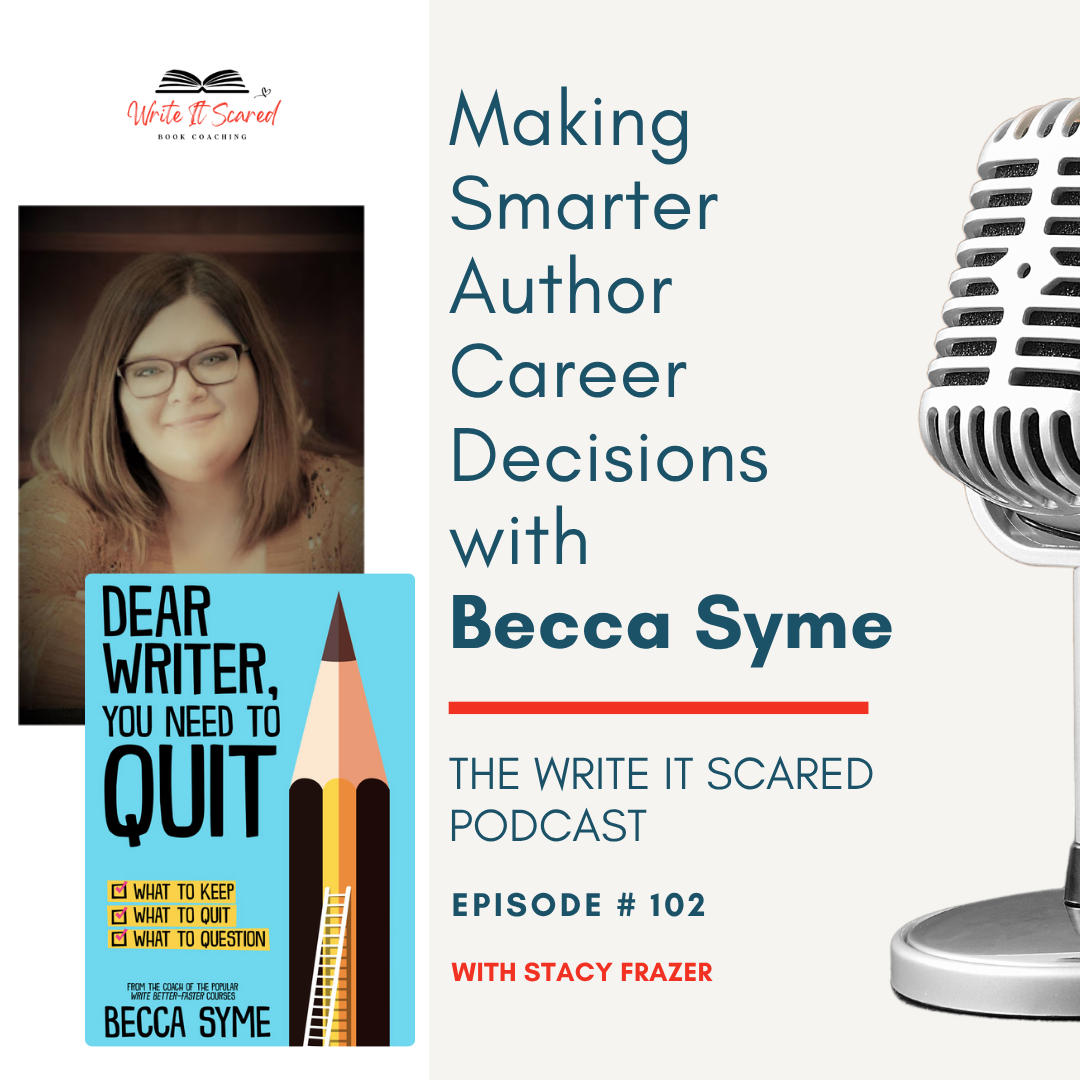
Becca’s upcoming book, Dear Writer, You Still Need to Quit, is not a refresh of her original Dear Writer, You Need to Quit (But I highly recommend you read that, too–and you can even get a free copy here.)
Dear Writer, You Still Need to Quit is an entirely new book written for a completely different publishing landscape from the one writers faced even five years ago. Her aim with this book is to cut through the noise of all the “should do’s” and “could do’s” so that authors can make the best and most aligned decisions given where they are on their author’s journey.
The New Publishing Landscape and Resulting Problems For Readers and Writers
There was a period—roughly between 2010 and 2018—when publishing felt wide open.
Independent publishing became more mainstream with platforms like Amazon Kindle Direct Publishing, providing access to digital downloads and on-demand books. Suddenly writers had more direct access to readers than ever before. More books were getting discovered organically. There were fewer authors competing for attention, and it was much easier to release a book and see some traction without spending much money on advertising or marketing.
That’s not the world we live in now.
Today’s book market is saturated. Readers have more options than they know what to do with, and when people are faced with too many choices, they don’t get excited. They get overwhelmed.
Becca compares it to walking into a grocery store and trying to choose from hundreds of types of peanut butter. Eventually, you stop trying to make the “perfect” decision and look for someone else to guide you. That’s what readers are doing now, too. They rely on curation. On BookTok, algorithms, curated lists, and trusted recommendations to narrow down their choices.
That means your book isn’t just competing on quality anymore. It’s competing for attention.
And that changes the way you need to approach introducing it to the world.
Why Your Book Not Selling Doesn’t Mean It’s Bad
One of the biggest mistakes writers make is assuming that if a book doesn’t sell, it must not be good enough.
But Becca says, in today’s market, “it didn’t sell” is not a clean data point.
It may mean the right readers never saw it. Maybe you launched during a crowded release week for a similar book. (Any romantasy author who released during the time Iron Flame came out can probably relate).
Becca points out that in some genres, more than 200 new books are released every single week. When that’s the environment readers are navigating, it’s no wonder books get missed.
All that doesn’t mean the book failed. It means the writer may not yet have enough visibility, infrastructure, or audience connection for that book to consistently find readers.
And that’s where understanding the stage of your author career becomes incredibly important.
The Five Phases of an Author Career
One of the most useful concepts in Becca’s new book is the idea that author careers move through phases. Each phase has different priorities, challenges, and decisions for the writer.
The problem is that many writers are trying to make phase three decisions while they’re still firmly in phase one.
Phase One: Research and Development
This is where most writers begin.
You’re figuring out what you write, who it’s for, and whether there’s enough demand for it to build a career around. You’re experimenting. You’re releasing books and trying to see what connects.
This phase is often slower and less profitable than writers want it to be. That’s normal.
According to Becca, phase one is not about scaling. It’s about gathering information. It’s about asking:
Can I find readers for this? Can I identify where the demand is? Can I repeat this success?
If you’re still figuring out those answers, it may not be time to invest heavily in audiobooks, translations, or expensive ad campaigns.
Why Writers Make Expensive Decisions Too Early
Once writers feel discouraged, the instinct is often to do more.
More formats. More spending. More marketing.
So people jump into direct sales, Kickstarter campaigns, translations, merchandise, or audio because they see other authors doing it successfully.
But Becca makes a really important distinction in this conversation: is the money being spent an investment—or is it speculation?
An investment is based on proven demand. Speculation is spending money in the hope that demand might appear later.
There’s nothing wrong with speculation if you can afford to lose the money. But a lot of writers can’t. They’re making expensive business decisions before they’ve proven that readers want the product in the first place.
That’s where understanding your phase becomes so helpful. It keeps you from pouring time, money, and energy into infrastructure that your business may not need yet.
Phase Two: Proving Demand
Once you know something has sold, phase two asks a new question:
Can you do it again?
Can you continue producing the kind of work readers responded to? Can you build enough consistency that you’re not relying on one lucky launch or one successful book?
This phase can take years. And that’s something writers often underestimate.
You may need multiple books before you know whether you’ve found a renewable demand pocket. You may need time to see whether readers return for your next release. That doesn’t mean you’re behind. It means you’re still gathering data.
Phases Three and Four: Infrastructure and Growth
Once you know there is demand, then it starts to make sense to ask bigger questions.
Should you add audiobooks? Should you invest in translations? Should you hire help? Should you build new systems or refine existing ones to make your business run more efficiently?
Phase three is about building the infrastructure to support growth.
Phase four is about testing whether that infrastructure actually creates more income. Becca explains that these two phases often bounce back and forth. You add something, see if it works, then decide whether it makes sense to expand further.
This is the phase where hiring an assistant, outsourcing ads, or creating multiple income streams may finally make sense.
But only if the demand is already there.
Phase Five: Maturity
Eventually, a business reaches a point where growth slows and becomes more stable.
At this point, you’re no longer doubling your income every year. Instead, you’re building a sustainable business with a strong backlist, a recognizable brand, and a loyal audience.
Becca describes this as having “renewable demand.” Readers know what kind of experience they’re going to get from you, and they keep coming back for more.
That doesn’t mean there are no ups and downs. It just means you’ve built something steady enough to weather lean moments.
You Don’t Have to Write to Market
One of the most reassuring parts of our conversation was Becca’s reminder that not every writer is built to write to market.
Some writers are natural “drafters” who can study trends, shape their work around reader demand, and enjoy doing it.
But many writers are what Becca calls “evergreens.” They write what naturally comes to them, and their best strategy is often to grow where they’re planted instead of trying to shapeshift into whatever trend is hot at the moment.
For those writers, paying too much attention to the market too early can actually be stifling.
It can make the writing worse. It can make the process less joyful. And it can lead writers to abandon the stories they were meant to tell.
Sometimes the better choice is to write the thing that lights you up first and worry about positioning it later.
Part Shot
I think what struck me most in this conversation is that so much of our anxiety comes from trying to make decisions that belong to a future version of us.
We’re trying to act like a mature business before we’ve found our readers. We’re trying to scale before we’ve proven demand. We’re trying to build infrastructure for a house that doesn’t exist yet.
And no wonder that feels exhausting.
Understanding the stage of your author career doesn’t solve everything. But it does help you make smarter decisions. It helps you stop comparing yourself to people who are ten steps ahead of you. And it helps you trust that just because your first book didn’t sell or you don’t know what the next step is, it doesn’t mean you’re failing.
It may simply mean you’re still in the early phases of building something.
And that’s okay.
You can learn more about Becca’s work through the Quit Cast for Writers, her Patreon, and her upcoming book, Dear Writer, You Still Need to Quit, through her website.