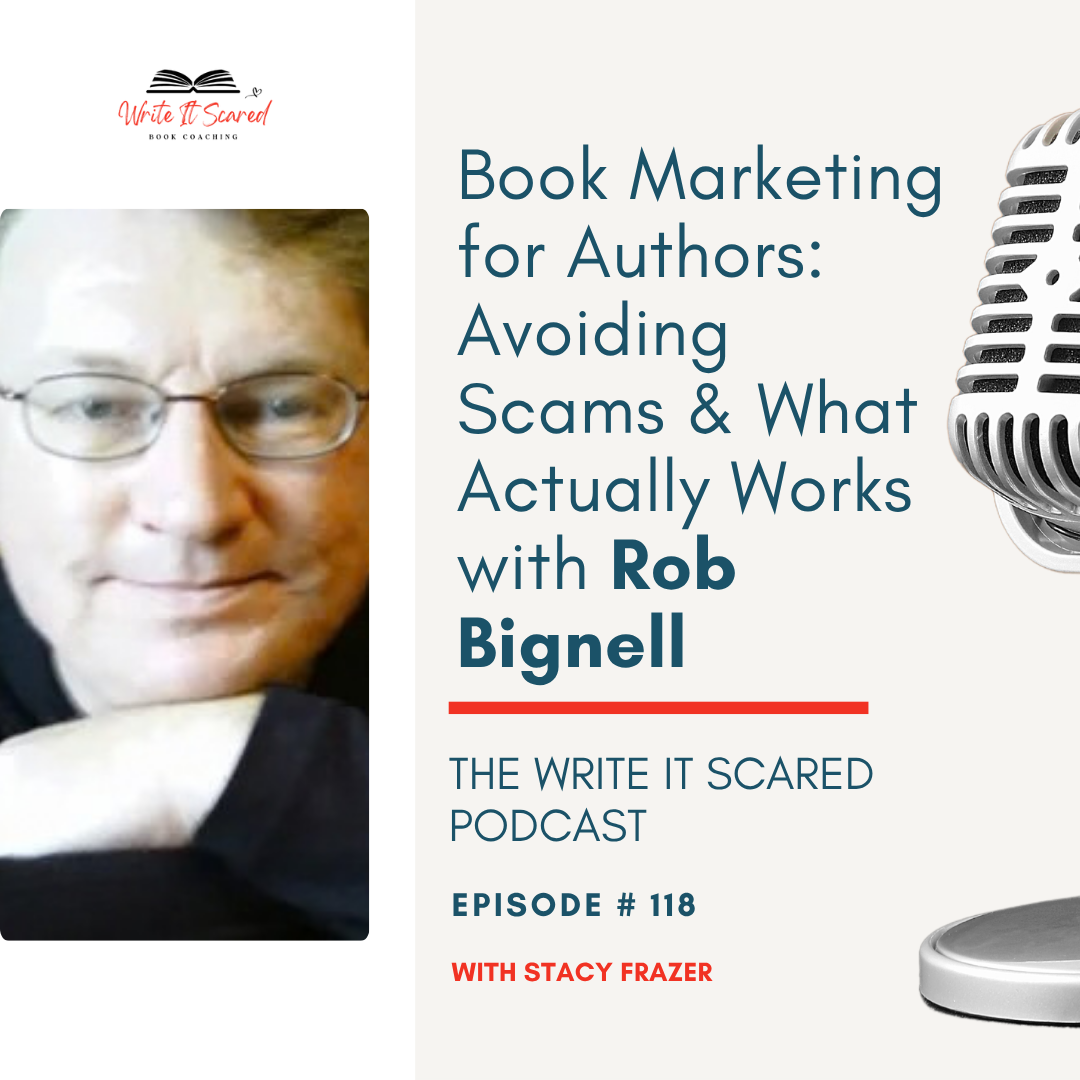
Book Marketing for Authors: Avoiding Scams & What Actually Works with Rob Bignell
You spent a year writing your book. Maybe two. Maybe five. You revised it to death, agonized over the cover and blurb, finally hit publish…and sold three copies…in a year.
Ouch.
That’s a vulnerable place to be.
You’ve invested enormous time, energy, hope, and probably money into this book, and you want people to find it and love it. So when someone suddenly appears in your inbox promising to get your book in front of thousands of readers, make it go viral on TikTok, or connect you with a big-name publisher, it can be very tempting to listen despite the too-good-to-be-true nature of the offer.
And book scammers know it.
That’s what author and longtime editor Rob Bignell and I talked about on the Write It Scared Podcast: why authors are increasingly being targeted by book marketing scams, how to recognize when an opportunity isn’t what it claims to be, and how to approach legitimate book marketing without losing your money, your mental marbles–or worse, burn out and give up.
Rob began researching book marketing scams after noticing a flood of suspicious emails offering to market his own books. The messages sounded good, but because he understood the publishing industry, he knew the services being promised either wouldn’t work or didn’t make sense. That research eventually became his book Protecting Yourself Against Book Marketing Scams.
Why Writers Make Such Good Targets
One thing from Rob's book that really stood out to me was the emotional component of these scams.
Authors aren't vulnerable because we're not intelligent.
We're vulnerable because we care and it’s overwhelming to know where to start with marketing.
New indie authors are particularly vulnerable because they're often learning publishing and marketing at the same time. Maybe your book isn't selling, so you start researching. Should you redesign the cover? Run ads? Make TikTok videos? Hire a publicist? Work on your SEO?
Then someone lands in your inbox saying, Hey, I can do exactly that for you.
Except you may not yet know what that service should cost, what realistic results look like, or whether the strategy makes sense for your book.
And the promise usually touches the thing we want most: visibility.
If an offer hits you directly in the “Finally, someone sees how good this book could be” place, that's probably the moment to slow down.
Verify First. Trust Later.
If I had to boil my own approach to avoiding scams down to one rule, it would be this:
Online, verify first. Trust later.
An unsolicited offer doesn't automatically mean something isn’t legit, but it should make you cautious, particularly if someone is promising results that sound unusually good. Especially if said promise comes from a gmail address.
Rob described scammers impersonating legitimate hybrid publishers, literary agents, editors, authors, beta readers, and other publishing professionals. Some create websites or email addresses that look close enough to legitimate ones that a writer moving quickly might not notice the difference.
So don't move quickly.
Research the company independently rather than clicking whatever link they sent you. Find the professional's real website and contact information. Look for an established online presence and complaints. Ask other writers if they've heard of the service.
And pay attention to whether the offer even makes sense.
A legitimate professional should be able to explain who they are, what they're offering, what it costs, and what you can reasonably expect to receive.
You don't owe someone your trust simply because they know the title of your book.
AI Has Made It Easier to Find—and Fool—Authors
Authors need to be visible online. We build websites, create social media accounts, write bios, and make it easy for readers and publishing professionals to find us.
Unfortunately, that also makes us easier for scammers to find.
Rob explained that automated tools can scrape the web for author information and email addresses. He recommends limiting how publicly accessible your primary email is by using a website contact form instead of posting your address directly.
AI can also make a lousy service look more legitimate. Rob described supposed beta readers who run a manuscript through AI and return what amounts to a generated summary instead of an actual thoughtful read. In other cases, a cheap or free initial service becomes the entry point into a much more expensive offer, like copyediting.
Before you hand over money—or your entire manuscript—know who you're dealing with.
If Something Smells like Spam, Don’t Engage. Report it.
Rob recommends not opening or engaging with spammy emails. Instead, report suspicious emails as spam or phishing.
If you're genuinely intrigued by an offer, research it somewhere else. Don't use the contact information the stranger provided to prove they're legitimate.
Go find the company yourself.
Protecting Yourself Doesn't Mean Hiding From Marketing
Marketing is already overwhelming enough for writers. The answer to learning that scammers are everywhere isn't to decide, Oh, Well. Guess I'll never market my book. NO WAY. You’ve come too far to stop now!
There are legitimate people providing excellent services to authors. And there are marketing strategies you can learn and implement yourself.
The trick is understanding that no single marketing strategy works for every author.
Rob pointed out that marketing a nonfiction hiking guide is different from marketing a children's book. The strategy also has to work for the person doing the marketing. Someone who loves speaking in front of a crowd has different options than someone who would rather eat their laptop than give a live presentation.
That matters because marketing advice tends to sound like commandments.
You have to be on TikTok. You need to make Reels. You need a newsletter. You need to run ads.
Nope.
You don't need to do everything. And definitely don’t try to do everything you think you should do all at once.
You need to understand your books, your readers, your strengths, and the strategies you're choosing well enough to make informed decisions.
Build Your Author Platform a Little at a Time
Rob's advice for newer authors was refreshingly unsexy: start small.
Build an author website you control. Begin developing an online presence before the book releases. Choose social platforms intentionally instead of trying to be everywhere. Gradually make connections with readers, writers, podcasters, bloggers, booksellers, and people in your corner of the publishing world.
Then keep going.
Rob suggested that even fifteen minutes a day devoted to marketing can gradually build an author platform. He compared it to writing a novel: a thousand words today doesn't look like a book, but repeat that effort consistently and eventually you have a completed manuscript (if only it were only that easy right?!) But the principle checks out! Work out a little and often and you’ll make a book.
Marketing, like writing, is a long game.
Small efforts repeated over time build relationships, visibility, knowledge, and eventually an audience.
And knowledge makes you harder to scam.
The more you understand how publishing and book marketing actually work, the easier it becomes to recognize an offer that doesn't pass the sniff test.
Parting Shot
Publishing a book puts you in a vulnerable position. You made something you care deeply about, put it into the world, and now you want other people to care about it too.
There is nothing foolish about wanting that.
But wanting your book to succeed can make an impossible promise sound a little more plausible than it otherwise would.
So when somebody shows up promising visibility, sales, virality, publishing connections, or some other shortcut to the outcome you desperately want, slow down.
Verify first. Trust later.
And remember that legitimate book marketing usually isn't an overnight explosion anyway. It's a series of small, intentional efforts that help readers discover who you are and what you write.
That's less exciting than somebody promising to make your book go viral—but it’s sustainable. And that, my friend, is the real name of the author game!
Connect with Rob Bignell
Rob Bignell is a longtime professional editor and the author of more than 80 books, including Protecting Yourself Against Book Marketing Scams. Through Inventing Reality Editing Services, he provides fiction and non-fiction editing and has written thousands of free articles on writing, publishing, grammar, and book marketing.