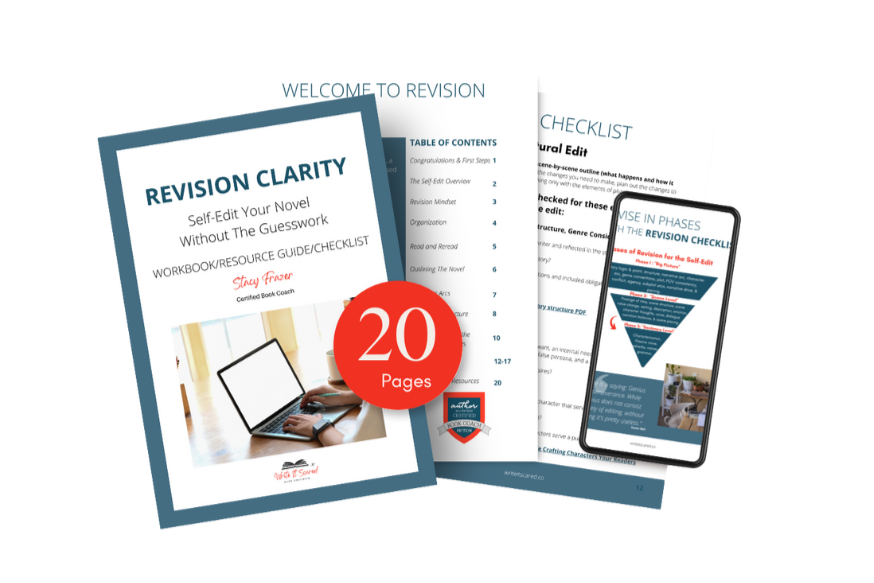
Do you edit your first draft? Or do you revise?
Potato, potahto—some say.
Not me. I’ve made that mistake before.
Revision and editing are not the same thing, and confusing them is one of the fastest ways to frustrate yourself, lose momentum, or convince yourself you’re “bad at this.”
What Revision Actually Is
Revision, for me, means reimagining the book so the whole thing is cohesive, logical, and driven by a clear narrative engine.
It’s the Make It Make Sense Draft.
It’s about adding, deleting, and changing the big-picture elements of the story: adding a new character, a new subplot, a different twist, refining a main character’s motivation, strategy, or backstory, and so on.
This is the stage where I make sure the entire novel has a “because this happens, then this next thing happens” logic. As well as ensuring my protagonist is pursuing a difficult goal and encountering obstacles that compel them to act and make choices with costs (i.e., stakes).
Often, those elements aren’t present in the first draft—or not in the right order—and I have to fix them.
Sometimes that means throwing a lot of shit out and rewriting.
Sometimes it means throwing out that rewrite, too.
Efficiency is not a word I associate with revision (not really)—even though I know how to make the process more intentional and straightforward. Nope, it’s still messy, sometimes uncomfortable work, but let’s not forget that it is also fun (though that often gets overshadowed.)
It’s fun to make the puzzle pieces connect, and that’s what revision does… eventually.
And, you know, I’ve learned that the only way out of a revision mess is to just go through it.
For example, my YA suspense cuts file sits just under 16,000 words. Full scenes gone. Partial scenes scrapped and rebuilt.
And for contrast: My first novel had a 60K cuts file—and the book itself wound up being 100K all said and done. So see, there is progress!
All that cutting, tweaking, reexamining, tossing … it’s all normal. And I don’t feel bad about deleting a single word. Every cut makes the story stronger.
What Editing Actually Is
Editing comes after you’ve wrestled the story into a logical beast.
Editing is refinement.
This is where I zoom in to the scene level:
I double-check that the scene has a clear purpose
Make sure my character is engaging with conflict and actively making decisions that move them forward, for better or worse
That I’ve grounded my reader in time, place, and emotional context
Make sure that something changes in each scene that contributes to the overall narrative drive of the story
This is also when I lock in chapter breaks, sharpen cliffhangers or add them, and look for ways to pull the reader into the next moment.
Sometimes I hit a spot that no longer works (cuz of the changes I’ve made), and it sends me back into revision mode for a while. That’s normal too. The process is iterative. And yeah, occasionally hiccupy.
After that comes line-level editing:
Refining character voice and dialogue
Deepening characterization
Layering in setting and sensory detail that has eluded me
Tightening the sentences, weeding out passive voice, and focusing on the rhythm of the prose
And finally, I review grammar and punctuation… and once again realize I still don’t fully understand commas or semicolons.
Why the Difference Really Matters
Here’s the part most writers don’t get told:
If you try to edit a draft that actually needs revision, you’ll feel like a failure.
You’ll nitpick sentences when the problem is structure.
You’ll polish prose when the story logic is broken.
You’ll blame yourself for being “stuck” when you’re just using the wrong tool for the job.
Revision asks you to think big.
Editing asks you to think precisely.
When you don’t know which mode you’re in, everything feels harder than it needs to be—and that’s when self-doubt creeps in.
Knowing the difference:
Protects your confidence
Keeps you from burning energy in the wrong place
Helps you trust that discomfort doesn’t mean you’re doing it wrong
It means you can say, “Oh, this isn’t broken. It just isn’t ready for editing yet.” And there’s no need to beat yourself up. Drop the stick, my friend.