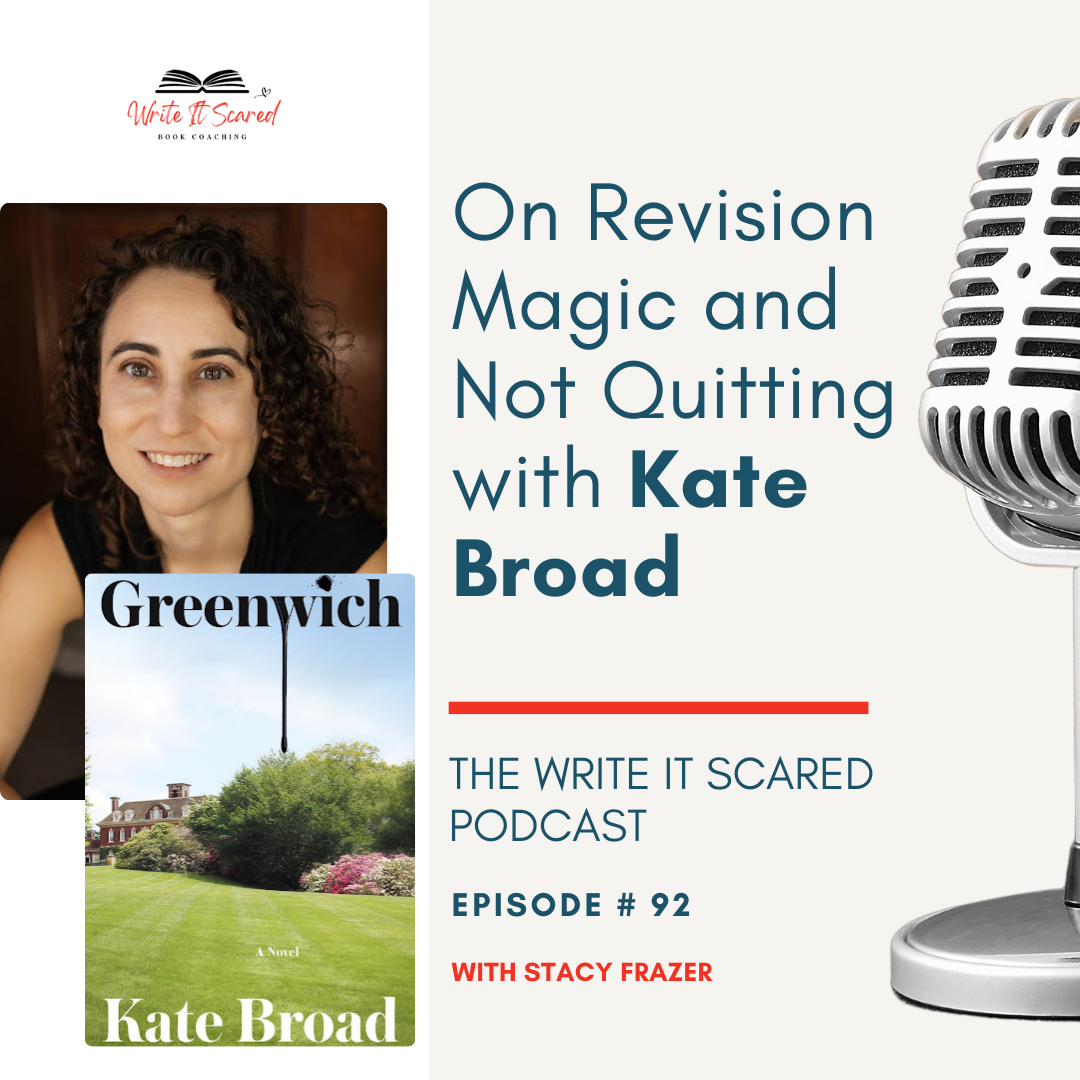
On Revision Magic and Not Quitting with Author Kate Broad
When writers talk about the creative process, there’s often an unspoken hope hiding underneath the conversation…
At some point, this will get easier.
But if there’s one thing this episode of the podcast makes abundantly clear, it’s this:
The novel writing process doesn’t necessarily get easier, but you feel more confident in your abilities by continuing to do it.
In a recent conversation, I spoke with novelist Kate Broad about her debut novel, Greenwich, a story about a young woman navigating a world of wealth and privilege while harboring a terrible truth no one wants exposed.
We tackled revision, self-doubt, and what it takes to keep believing in a novel until it’s done.
What emerged wasn’t a tidy success story. It was something far more valuable: an honest look at what writing actually asks of us.
Revision Is Where the Book Becomes Itself
One of the most comforting truths Kate shared was this:
It almost doesn’t matter what you start with, as long as you start.
Her first draft of Greenwich didn’t work. Early readers didn’t even finish it. Not because the idea was wrong, but because the tension and emotional weight that define the final book hadn’t been fully infused yet.
That work came later, through revision.
Revision, as Kate describes it, isn’t just about fixing sentences or polishing prose. It’s about learning how to layer what isn’t said, how to build pressure beneath the surface, and how to let silence, restraint, and implication do as much work as dialogue.
That kind of depth doesn’t arrive fully formed. It’s built draft by draft.
Starting Over Isn’t Failure. It’s Craft.
At one point, Kate made a massive change: she rewrote the novel from third person into first.
That decision wasn’t cosmetic. It was about proximity. About getting closer to a narrator who is complicated, morally messy, and often uncomfortable to sit with.
Writing from inside that voice wasn’t easy, and the difficulty was the point.
Sometimes the work feels hard because it is hard. Because you’re writing the version of the book that asks some very hard questions; ones that don’t have easy answers.
The Book You’re Writing Now Isn’t Easier. And That’s Normal.
One of the biggest myths writers internalize is that once you publish a book, the struggle disappears.
It doesn’t.
Kate talked candidly about writing her second novel and how familiar doubts resurface, even with a successful published book behind her.
Each book presents a new puzzle. Each one asks you to level up. The challenge grows because you grow.
That doesn’t mean you’re doing something wrong. It means you’re doing something ambitious.
The Only Real Way Through Is To Keep Going
When writing gets hard—really hard—there’s a temptation to quit. To assume that difficulty means you're not capable.
But Kate’s approach is refreshingly simple:
Quitting isn’t an option.
That doesn’t mean white-knuckling your way through misery. It means removing “giving up” from the list of possible responses. It means trusting that confusion, frustration, and doubt are part of the process, not signs you should stop.
You don’t need to feel confident to keep going. You just need to keep going.
Writing Is the Reward
Perhaps the most powerful moment of the conversation came when Kate discussed why she writes, independent of publication, praise, or outcomes.
There’s a moment when a manuscript takes on a life of its own. When you’re solving the puzzle and creating it at the same time. When the work becomes immersive, demanding, and alive.
That feeling doesn’t come from ease.
It comes from engagement.
And that engagement with our work is truly why we write.