Writing Middle Grade Historical Fiction: Shafaq Khan on Craft, Revision, and Persistence
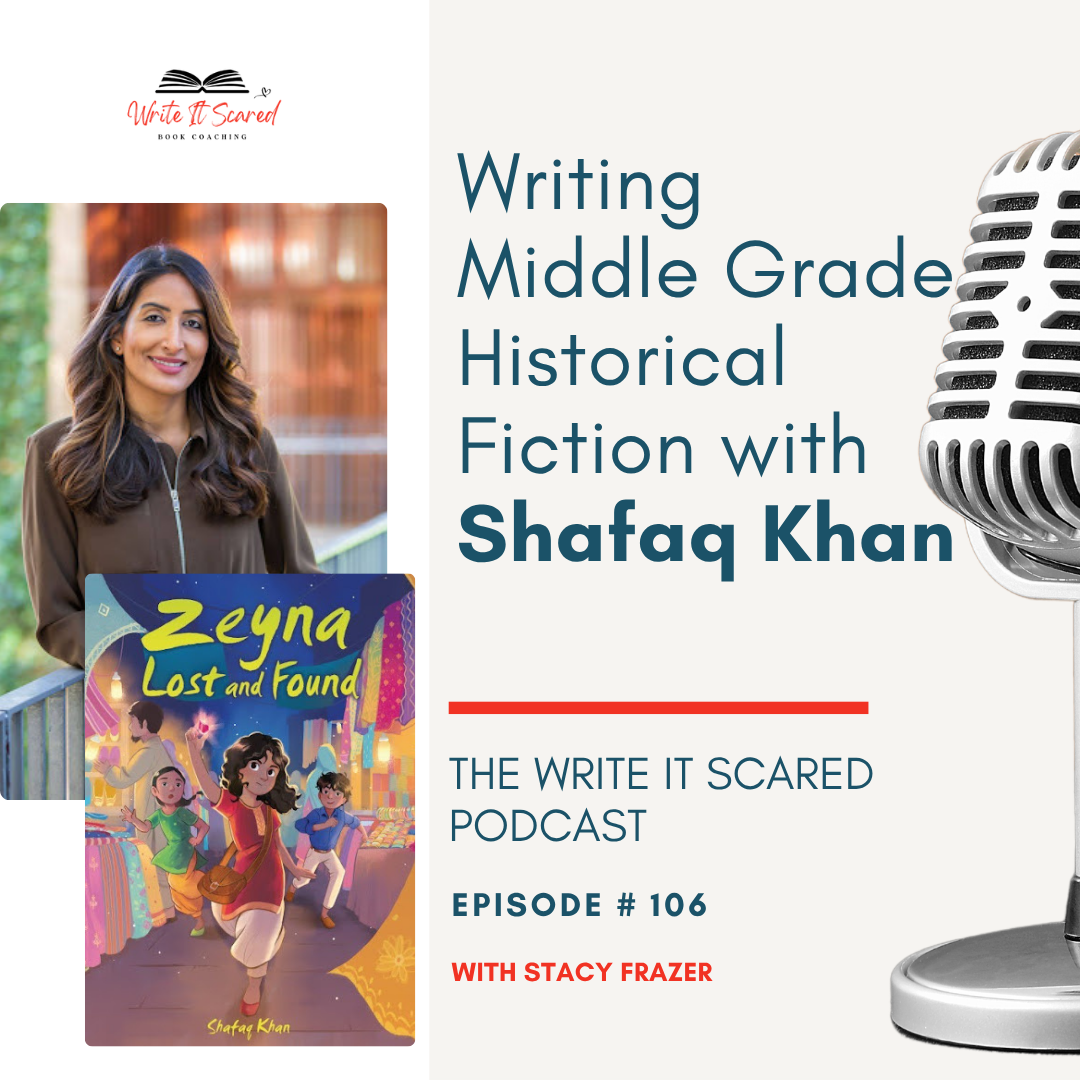
This week on the podcast, I sat down with author Shafaq Khan to talk about the long road from idea to publication for her debut middle grade historical fiction novel, Zania: Lost and Found. We discussed the challenge of balancing historical context with a fast-paced adventure story for kids, and what it means to keep writing through years of uncertainty and revision.
This conversation was a beautiful (and needed) reminder that books are often built slowly, imperfectly, and through tremendous persistence.
A Story Inspired by Real History
Zaina: Lost and Found follows a 12-year-old British Pakistani girl named Zaina who feels caught between worlds. She doesn’t quite feel like she belongs at school, at home, or fully within either side of her identity. So she escapes into mystery-solving fantasies and detective stories—until a real mystery lands in her lap.
After a strange man begins following her family, Zaina’s parents suddenly disappear during a trip to Pakistan and are accused of stealing a precious jewel. Determined to clear their names and find them, Zaina embarks on an adventure across Pakistan, Afghanistan, Iran, and Turkey along the real-life “Hippie Trail” of the 1970s.

What fascinated me most was that much of the setting was inspired by Shafaq’s own mother-in-law, who actually made a similar overland journey from Pakistan back to London with her family in the early 1970s. Hearing about that experience sparked Shafaq’s curiosity about what travel along those routes looked like during that time period and what it might feel like for a young girl trying to navigate both external danger and internal questions of belonging.
And honestly, the amount of research she poured into this book is staggering.
She studied travel journals, photographs, letters exchanged between travelers, historical accounts of the Hippie Trail, and political and cultural history from each region. She researched everything from the hostels travelers stayed in to the restaurants they frequented in Kabul and Tehran.
But what I appreciated most was hearing her talk about the balancing act required when writing historical fiction for younger readers.
Because historical fiction is not a textbook.
You have to decide what to include, what to leave out, and how to weave in political and cultural context without losing the story's momentum. Shafaq was very aware that younger readers would primarily follow Zaina’s external adventure, while slightly older readers might begin to pick up on the deeper historical and political undercurrents layered into the book.
The Story Changed Dramatically During Revision
One of my favorite parts was hearing how much the book evolved over time.
Shafaq knew the world of the story very early on. She understood the historical backdrop, the locations, and the emotional themes she wanted to explore.
But the actual shape of the adventure story came together later.
And like so many writers, she discovered that the outline she started with barely resembled the final book.
There were too many adult characters in early drafts. Some of the action came too late. Certain sections leaned too heavily on historical description rather than keeping the narrative moving. Over time, the story became more focused on Zaina herself—her choices, her perspective, and her emotional growth.
I loved hearing her talk about how iterative the process was because it’s an important reminder; especially for newer writers who might think that novels are written perfectly, and wholly in a single draft.
They don’t.
They evolve. Sometimes dramatically.
And often the process of revision is really the process of discovering what the story was actually trying to become all along.
The Power of Middle Grade Stories
At one point in our conversation, we discussed why Shafaq ultimately chose to tell this story from the perspective of a 12-year-old girl.
Originally, she imagined the protagonist being older. But the more middle-grade novels she read, the more she realized there was something uniquely powerful about that age.
That in-between space where kids are becoming more aware of the world, more aware of themselves, and more aware of where they do—or do not—feel like they belong.
And that really became the emotional heart of the book.
Yes, Zaina is solving a mystery and traveling across countries trying to find her parents. But underneath that external adventure is a deeper internal journey about identity and belonging.
She doesn’t feel British enough.She doesn’t feel Pakistani enough.She doesn’t fully know where she fits within her family, her friendships, or even herself.
And through the course of the story, she slowly begins choosing belonging instead of waiting for someone else to give it to her.
The Hardest Feedback She Received
Like many writers, Shafaq experienced moments during revision where the entire project felt like it might collapse.
One particularly difficult round of feedback came late in the process, when a trusted reader admitted they were struggling to follow the mystery itself. The clues felt confusing. The core thread of the plot wasn’t landing.
And once Shafaq heard that, she couldn’t unsee it.
That feedback led to a major rewrite, including cutting or minimizing several adult characters so that the story’s momentum stayed centered on Zaina and her companions instead of the adults around them.
I really appreciated her honesty here because sometimes the most painful feedback is the feedback that’s right.
The kind that forces you to step away from the manuscript for a while before you can even begin figuring out how to fix it.
What helped her move through that revision was organization. She separated feedback into categories: overall plot issues, chapter-level concerns, and line-level edits. Then she tackled them systematically instead of trying to hold the entire mess in her head at once.
Practical advice for revision.
The Long Path to Publication
Shafaq’s publication journey also took time.
She began working on the book in early 2018 and attempted to query it in 2021. The querying process was difficult, and many traditional cold queries went nowhere. Eventually, an introduction through the Society of Children’s Book Writers and Illustrators (SCBWI) helped connect her with the agent who would eventually represent her.
Even after signing with an agent, the book received numerous rejections from publishers.
Some editors loved the voice but were hesitant about historical fiction in the middle grade market. Others already had similar projects on their lists. One editor suggested trying the manuscript in present tense instead of past tense—a change Shafaq ultimately made because it increased the immediacy and tension of the story.
Eventually, the manuscript found its home with Lerner Publishing Group, where her editor deeply understood both Zaina’s external adventure and her emotional arc.
Learning to Trust Her Own Voice
Toward the end of our conversation, I asked Shafaq what she learned about herself through this process.
Her answer stayed with me.
She said that writing this book grounded her during a time when much of life felt uncertain and outside of her control. Through years of revision, waiting, and second-guessing, she slowly learned to trust her own voice more deeply.
Not blindly. Not arrogantly.
She still values feedback. She still seeks out critique and revision. But she now feels more willing to take creative risks and trust herself to find the story as she writes it.
Such an important distinction.
Confidence as a writer doesn’t usually arrive as certainty.
More often, it looks like continuing anyway.
Final Thoughts
One of the things I loved most about this conversation was how honest Shafaq was about the sheer length and messiness of the process.
This book took years to write, revise, query, sell, edit, and publish. There were moments she considered shelving it entirely. There were painful rewrites, long waits, difficult rounds of rejection, and constant uncertainty.
And yet she kept going.
I think that’s important for all writers to hear because we live in a culture that loves overnight success stories. But most books aren’t built overnight. Most careers aren’t built overnight.
They’re built through persistence. Through revision. Through staying with the story long enough to discover what it’s really trying to say.
And sometimes, through learning to trust your own voice a little more each time you return to the page.
Where to Connect with Shafaq Khan
You can connect with Shafaq Khan here:
Her debut middle-grade novel, Zaina: Lost and Found, is available through bookstores, libraries, Bookshop.org, and major retailers.